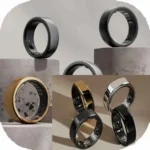
Smart rings are currently having a major moment. They offer the intriguing promise of continuous health tracking in a form factor that’s vastly more discreet than a bulky smartwatch. You’ve likely heard of the major players in this space, such as the Oura Ring (which often requires a subscription for its best features) and the recently released Samsung Galaxy Ring.
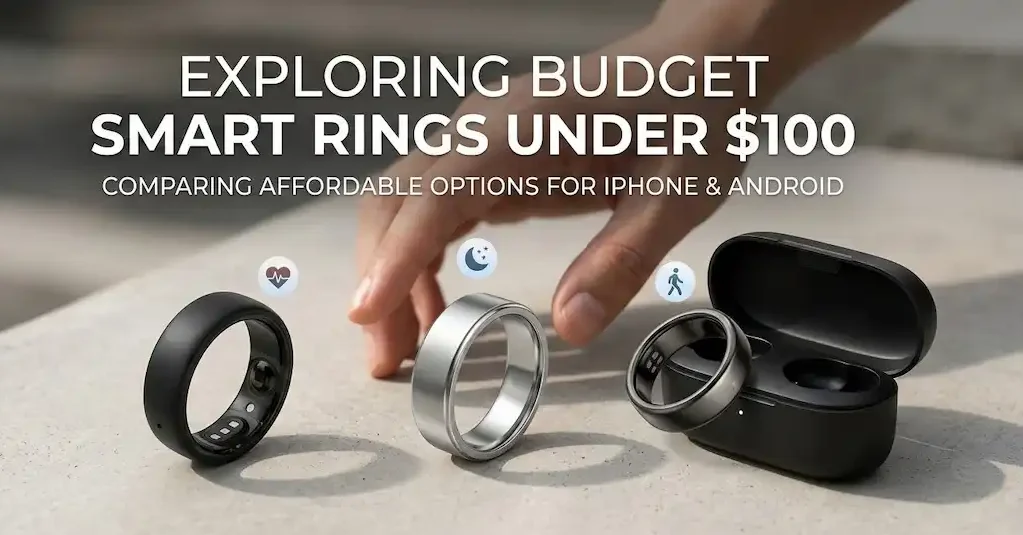
However, these premium devices often come with a price tag starting around $300. This has left many people wondering if it’s possible to get the core smart ring experience without such a significant investment. The short answer is yes: there is a thriving, if rapidly evolving, market for budget smart rings under $100.
But while the concept is the same, the execution in this price bracket varies wildly. Navigating this landscape requires careful consideration of what you are actually getting for your money, and what compromises you are making. Let’s dig into what this market really looks like and how these more affordable options compare.
The Landscape of Budget Smart Rings
When I first slipped on a sub-$100 ring, I expected it to be a glorified pedometer. I was pleasantly surprised. While they lack the medical-grade prestige of the Samsung Galaxy Ring, these affordable alternatives handle the “Big Three” quite well: heart rate, sleep duration, and step counts.
However, choosing budget smart rings is a game of trade-offs. You aren’t just paying for the titanium; you’re paying for the “math” (algorithms) that turns sensor light into health data. In my experience, cheaper rings are great at showing you trends—like noticing your heart rate was higher after a late-night pizza—even if they aren’t quite as precise as a chest strap.
- The Entry-Level from Established Brands: This is the most exciting development in the last year. Companies that already have a significant footprint in affordable fitness trackers (like Amazfit/Zepp Health or Indian giant BoAt) are scaling down their technology into the ring form factor.
- Generic/White-Label Manufacturers: This category includes dozens of brands you’ve likely never heard of (Colmi, various options on Amazon/AliExpress). These are often manufactured by a handful of large factories, using common sensors and white-label applications.
In both cases, these rings target the core functionalities popularized by high-end devices: heart rate, blood oxygen (SpO2), activity (steps), and sleep tracking.
What you won’t find in this price range are advanced features like ECG (Electrocardiogram) monitoring, contactless payments (NFC), or highly personalized recovery algorithms like Oura’s “Readiness Score.” The hardware is simpler, and the app ecosystems are vastly different.
Common Misconceptions About Budget Smart Rings
Before we discuss specific models, it’s crucial to address a few misconceptions that often confuse potential buyers.
“They All Use the Same Tech”
While it’s true that many generic rings share components, it is not true that they are all the same. The difference lies in the sensors and the algorithms. A $30 ring might use an older generation heart rate sensor that struggles during movement, whereas a $99 ring from an established brand might use components and algorithms trickled down from their high-end smartwatches.
“If It Syncs, It’s Accurate”
This is the biggest pitfall in the budget wearable space. A device can successfully display data (like “10,000 steps”) on its app, but that doesn’t mean the measurement is precise. All budget trackers, especially those without GPS (which none of these rings have), rely on accelerometer data and math. The quality of that math is what determines accuracy, particularly for complex metrics like sleep stage analysis (deep sleep vs. REM sleep).
A Practical Guide to Budget Smart Rings: The Pros and Cons
If you are considering stepping into this market, you need to understand the fundamental trade-offs involved.
The Pros (Why You Might Want One)
- Cost of Entry: This is the obvious one. You can test the waters of the smart ring experience for $50 rather than $300+.
- The Form Factor: The core appeal remains. A budget smart ring is still a ring. It is lightweight, does not have a glowing screen, and is comfortable enough to wear to sleep, which is where it often excels compared to a smartwatch.
- Fundamental Health Trends: Even a less accurate sensor is useful for identifying trends. If a ring consistently tells you that you are sleeping poorly, that trend is valuable, even if the exact minutes of REM sleep might not be medically precise.
- No Subscription Fees: Perhaps the biggest advantage. Unlike the Oura Ring, the vast majority of budget rings (especially from manufacturers like Amazfit and generic brands) give you full access to all your data and analysis without charging a monthly fee.
- Niche Features: Some budget rings have unique “trick” features. The BoAt Smart Ring Active, for instance, includes gesture controls, allowing you to control music or act as a remote shutter for your phone’s camera.
The Cons (The Compromises You Make)
- Sensor Accuracy: We’ve discussed this, but it’s critical. Heart rate during exercise is often poor. Sleep stage detection (distinguishing between light/deep/REM sleep) is generally more generalized on budget devices.
- Application Quality: The app is 50% of the smart ring experience. Budget ring apps are often less polished, can have translation issues, or may not provide meaningful insights from your raw data. They often lack the depth of “recovery” coaching found in higher-end ecosystems.
- The Sizing Crisis: High-end brands send you a plastic sizing kit first. Budget brands rarely do. You often have to rely on their size charts, and getting the wrong size is a common issue that significantly degrades sensor performance.
- Materials and Durability: Premium rings are often made of grade 5 titanium and coated for scratch resistance. Budget rings are usually stainless steel (which is heavier and easier to scratch) or even plated plastic. They may not be as rugged as their counterparts.
- Battery Management: The hardware inside is less sophisticated, meaning power management is less efficient. You may find battery life degradation happens faster over the first year compared to premium alternatives.
iPhone and Android Compatibility in the Budget Space
In my testing, budget smart rings generally play nicer with Android because of the more open Bluetooth protocols. If you’re on an iPhone, you might find that you have to keep the app open in the background to ensure your data syncs consistently. However, most modern rings now support Apple Health and Google Fit, so your data isn’t trapped in a proprietary bubble.
Premium offerings like the Oura Ring offer a completely seamless, near-identical experience across both iPhone (iOS) and Android devices. This isn’t always true for budget options.
Android Advantage
In general, budget rings (and their apps) tend to work more easily with Android. This is because Android (created by Google) allows more open communication with Bluetooth devices. Features like gesture controls (as seen on the BoAt ring) and real-time data syncing usually work more reliably on Android.
iPhone Limitations
The iPhone (created by Apple) ecosystem is much more restricted. Apple places significant limits on how background processes (like a ring trying to sync data) work on iOS to preserve battery life and privacy.
When you use a budget ring on an iPhone, you might experience:
- Manual Syncing Required: You may need to open the app manually for it to pull data from the ring.
- Notification Issues: Some rings attempt to notify you of calls or texts (often with a vibration motor). On iOS, setting up and maintaining these connections is frequently difficult or unreliable.
- Data Disconnect with Apple Health: While most of these rings claim compatibility with Apple Health, the depth and frequency of the data they share can be limited compared to premium devices that deeply integrate.
It is absolutely essential that you read user reviews for a budget ring specifically mentioning performance with your phone’s operating system.
Core Use Cases for Budget Smart Rings
A key part of deciding on a budget smart ring is knowing what you realistically intend to do with it. Because these devices are compromises, they are better suited for some tasks than others.
The Best Use Case: Sleep Tracking
This is the primary strength of all smart rings, regardless of price. A ring is much less intrusive than a watch. If you primarily want to know how long you slept, how restless you were, and if your average nightly heart rate and SpO2 levels are stable, a budget ring can serve you very well. It is excellent at detecting wake/sleep cycles, which is the foundational piece of sleep tracking data.
The Moderate Use Case: Daily Activity Trends
A budget smart ring works well for general activity. If your goal is “get 10,000 steps a day” or “walk more,” it’s a perfectly acceptable tool. It provides a simple baseline to help you compare one day to the next.
The Poor Use Case: Precision Fitness Monitoring
A budget smart ring is the wrong tool for precision fitness. If you are training for a race and need medical-grade accuracy for heart rate zones, or if you need precise measurements during complex activities like cycling or weightlifting, a budget ring’s sensors will likely fail you. They are prone to error when moving, and the app algorithms are not sophisticated enough to filter out that noise.
Comparing Notable Budget Smart Rings Under $100
Let’s look at the actual contenders you are likely to find when searching this price range in 2026. This is where the landscape gets practical.
The Top Tier: Amazfit Helio Ring
The Amazfit Helio Ring is perhaps the most refined and “legitimate” option you will find pushing the $100 boundary. While it was launched at a higher price, it is frequently available at a discount that brings it just under our limit. It’s developed by Zepp Health, a company with a strong track record in budget fitness trackers.
- Primary Focus: Sleep, Recovery, and integration with Zepp’s wider ecosystem (which includes watches and scales).
- A Solid Foundation: This ring uses the same type of sensors and algorithms found in popular Amazfit watches. This provides a level of baseline accuracy that generic brands cannot match.
- Materials: It is lightweight (under 4 grams) and utilizes a skin-friendly titanium alloy, which is rare at this price point.
- The App: The Zepp app is robust, well-designed, and free of subscriptions (with some optional, non-essential paid features).
The main downsides are that it is frequently only available in a few core sizes (such as 8, 10, and 12), and the battery life is average, lasting about 4 days on a charge. It is a fantastic option if one of the limited sizes fits you and you value a reliable app ecosystem.
The King of Ultra-Budget: Colmi R02
This is the “standard” budget smart ring that defines the ultra-affordable space. You can often find the Colmi R02 (or essentially identical white-label versions) for $35 to $60. It offers an almost unbelievable feature set for the price, aiming to track heart rate, blood oxygen, steps, and sleep.
- Who it is for: The absolute beginner. If you are not sure if you will even tolerate wearing a smart ring at all, this is a very low-risk way to find out.
- The Experience: The hardware is surprisingly decent, using stainless steel and feeling substantial on the finger. The sensors work to provide basic data points.
- The App (The Caveat): The R02 usually pairs with an application like “QRing.” The app is functional but basic. The translations might be awkward, the interface is simplistic, and the insights from your data are almost non-existent.
The R02 is a “dumb” smart ring: it collects raw numbers reasonably well, but you cannot trust the advanced analysis (like sleep stages) and the app will not help you improve your health. It is an excellent data collector, provided you only care about general trends.
The Indian Market Innovator: BoAt Smart Ring Active
This is an excellent example of the entry-level from established brands. BoAt is a massive consumer electronics company in India, and their smart ring often retails for an equivalent price that converts to roughly $45.
- Distinct Features: The Ring Active focuses heavily on the user experience. It includes 6-axis motion sensors, allowing it to act as a rudimentary gesture controller (e.g., control music playback, skip tracks).
- Hardware and Charging: It has a solid stainless steel body and includes a portable charging case (similar to premium rings), which is extremely convenient.
- Focus on Use Case: The app focuses on “X-Factor scores,” simplifying the complex data into easier-to-understand metrics like “Activity Score” or “Body Energy Level.”
The BoAt ring has a slightly better battery life (around 5 days) and a significantly better app than the generic options. However, international availability can be an issue, and while the gestures are fun, they are not essential health tools.
Top Picks for Under $100
| Feature | Amazfit Helio Ring | Colmi R02 | boAt Smart Ring Active |
| Best For | Accuracy & Ecosystem | Ultra-Low Budget | Features & Style |
| Material | Titanium Alloy | Stainless Steel | Stainless Steel |
| Subscription | No | No | No |
| Battery Life | ~4 Days | ~6 Days | ~5 Days |
Conclusion
The market for budget smart rings under $100 is not a choice between “the best” or “the worst.” It is entirely a choice of finding the correct set of compromises for your specific needs.
If your primary goal is reliable sleep tracking with good app support and a known brand, the Amazfit Helio Ring (if on sale) is the clear winner. If you are an absolute beginner and just want to know if you can handle the form factor, the Colmi R02 is a perfectly fine, low-cost experiment. If you like the idea of added functionality like gesture control, and want a balanced experience, the BoAt Smart Ring Active is a strong choice.
Do not expect a $50 ring to perform identically to a $300 ring with a monthly subscription. But if you manage your expectations and use these devices for their intended purpose—identifying basic health and sleep trends—you might find that a budget smart ring is all you really need.
Frequently Asked Questions (FAQ)
Are budget smart rings as accurate as the Oura Ring?
No. High-end rings use more sophisticated sensors, better algorithms, and have years of R&D invested in interpreting that data. Budget rings are accurate enough to identify general trends (like nightly heart rate averages or sleep durations) but are not as precise for diagnosing medical conditions or tracking intense exercise.
What happens if I get the wrong size?
This is a significant problem. A loose fit means the optical sensors cannot make consistent contact with your skin, which drastically reduces accuracy or prevents tracking entirely. Conversely, a ring that is too tight is uncomfortable, especially at night when your fingers naturally swell. This is the biggest drawback of budget rings, as they rarely offer a sizing kit first.
Do budget smart rings offer contactless payments (NFC)?
No. Secure NFC payment requires specific, secure hardware (like a secure element chip) and licensing that is generally not possible at the sub-$100 price point. Some generic rings may offer simple, non-secure NFC functionality (like triggering an action on your phone), but this is not the same as a secure payment system.
How often do I need to charge a budget smart ring?
You should expect the battery to last between 3 to 6 days. This varies significantly based on how often the ring checks your heart rate and SpO2 levels. Because the battery is very small, it will naturally degrade over the first year of use.
Will my data be secure with a generic brand’s app?
This is a valid concern. When you use a white-label app (like QRing), you are uploading your data to servers (often located in China) managed by the manufacturer. While all manufacturers claim to secure user data, established brands like Amazfit (owned by Zepp Health) generally have more robust and transparent data privacy policies than generic, lesser-known brands.
Are these rings waterproof?
Yes, most budget rings offer at least an IP68 rating, meaning they are dust-proof and can survive immersion in water. Most are safe for washing your hands or showering. However, few carry the 10ATM or 20ATM (advanced water pressure) ratings needed for intense swimming or diving, which is sometimes found on more expensive wearables.
Will it track my period?
Some budget smart ring apps include “menstrual cycle tracking.” This is typically just a calendar-based logging system that you manually enter. Unlike the Oura Ring (which can use body temperature changes to predict cycles), budget rings under $100 do not include the medical-grade skin temperature sensors required for automatic tracking.
Additional Helpful Links
- Review the 5 Best Smart Rings – These are the 5 Best Smart Rings 2026
- Budget smart rings under $200 – 2026 Budget Smart Rings Under $200 – Subscription-Free