Why a Health Optimization Ring is the Ultimate Choice for Biohackers in 2026
I remember the exact moment I realized my smartwatch was lying to me—or at least, wasn’t telling me the whole truth. It was a few years ago, during a deep-dive “monk mode” month where I was testing how late-night blue light exposure affected my REM cycles. Every morning, my watch would give me a “sleep score” of 85, yet I felt like I’d been hit by a truck. When I finally swapped it for a dedicated health optimization ring, the data shifted. Suddenly, my Heart Rate Variability (HRV) readings were more granular, and my temperature spikes actually correlated with my physical state.
For the serious biohacker, “good enough” data is the enemy. We aren’t just looking for a step counter; we’re looking for a laboratory on our finger. In 2026, the market has finally caught up to our obsession. Whether you’re trying to pinpoint the exact milligram of magnesium that triggers deep sleep or you’re tracking your cardiovascular age to outrun Father Time, the right health optimization ring is your most powerful tool.
Why Smart Rings are the Biohacker’s Secret Weapon
If you walk into a room of longevity enthusiasts, you’ll notice a trend: bare wrists or traditional mechanical watches, but always a sleek band on the index finger. There’s a scientific reason for this that goes beyond aesthetics.
The Physics of the Finger
Biohacking is a game of “Signal to Noise.” Smartwatches sit on the wrist, an area crowded with bone, tendon, and thick skin. To get a reading, the watch has to “shout” through these layers. A health optimization ring, however, sits on the finger where the digital arteries are incredibly close to the surface.
From an insider perspective, the capillary density in your fingers provides a much cleaner photoplethysmography (PPG) signal. When I’ve spoken with engineers at leading wearable firms, they admit that the “motion artifacts”—the noise created when you move your arm—are significantly lower on a ring. For tracking HRV, which the Cleveland Clinic notes is a key indicator of your autonomic nervous system state, this stability is non-negotiable.
The Melatonin Factor
One of the biggest ironies of using a smartwatch for biohacking is the screen. If your goal is to optimize your circadian rhythm, having a miniature smartphone strapped to your wrist that glows with every “low battery” notification is counterproductive. Rings are passive. They don’t have screens, they don’t buzz with emails, and they don’t emit blue light in the middle of your sleep cycle. Using a health optimization ring allows you to gather data and wait for you to check it on your own terms.
The Best Smart Rings for Biohackers in 2026
I’ve spent the last year rotating through the top contenders. Here is the breakdown of which health optimization ring actually earns its place in a rigorous stack.
1. Oura Ring 4: The Data Architect
The Oura Ring 4 remains a gold standard because of its database. While other rings are still figuring out their algorithms, Oura has years of peer-reviewed research to back up its “Readiness Score.”
- The Insider Edge: Their new “Smart Sensing” technology uses over 15 signal paths. In my experience, this solves the “rotation problem.” Older rings would lose data if they slipped sideways; the Gen 4 stays locked on your vitals regardless of movement.
- Why it’s for you: If you use apps like Natural Cycles for hormone tracking or want the most validated sleep staging available, this health optimization ring is the clear choice.
2. Ultrahuman Ring Air: The Metabolic Specialist
If your biohacking journey is focused on glucose and metabolism, Ultrahuman is a standout. They’ve built an ecosystem that connects your health optimization ring data directly with their M1 Continuous Glucose Monitor (CGM).
- Personal Experience: Seeing how a high-carb dinner at 8:00 PM directly tanked my HRV and raised my body temperature by 0.4 degrees that same night was a “lightbulb” moment. No other health optimization ring integrates metabolic and recovery data quite this seamlessly.
- The Insider Edge: They offer a “Power Index” which factors in your stimulant intake (like caffeine) against your recovery, helping you time your espresso for peak productivity.
3. RingConn Gen 2: The Longevity Budget King
Don’t let the lower price point fool you. The RingConn Gen 2 is a beast when it comes to battery life—I’ve consistently hit 12 days on a single charge. For a biohacker, “data gaps” are a cardinal sin. If your health optimization ring dies at 3:00 AM, you’ve lost your recovery trend for the day.
- The Standout Feature: It’s currently leading the way in “Wellness Balance” monitoring, which visualizes your stress versus your activity in a way that feels more intuitive than a simple number.
Real-World Use Cases: How to Actually Biohack
Having the hardware is only 10% of the battle. The other 90% is what you do with it. Here is how I use a health optimization ring to actually move the needle:
Identifying Hidden Stressors
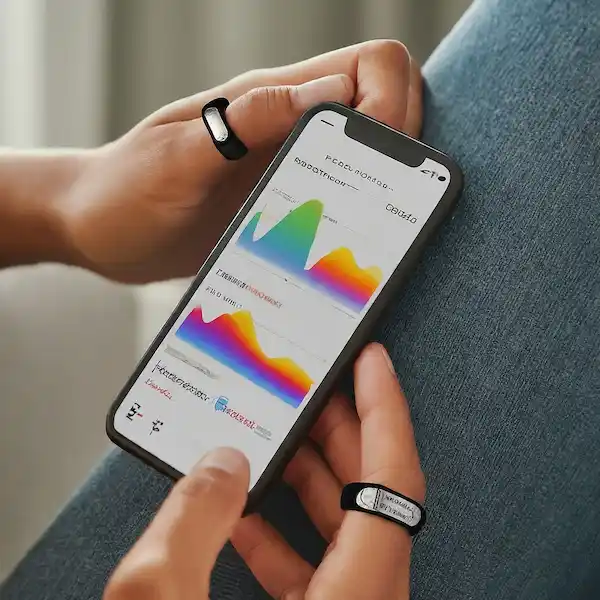
Last month, my “Stress Rhythm” chart showed a massive spike every Tuesday at 2:00 PM. I wasn’t in a meeting; I was just at my desk. It turned out that a specific supplement I was taking on Tuesdays (a high-dose B-complex) was triggering a sympathetic nervous system response. Without the continuous monitoring of a health optimization ring, I would have just assumed I was “having a weird day.”
Fine-Tuning Your “Cold Plunge”
Many biohackers swear by the morning ice bath. But did you know it can actually hurt your recovery if your HRV is already low? I use my health optimization ring readiness score as a “Go/No-Go” gauge. If my score is below 70, I skip the cold stress and opt for a sauna session instead. This prevents overtraining and keeps my cortisol levels in check, as suggested by research on exercise recovery.
Alcohol: The Ultimate Truth-Teller
Nothing humbles a biohacker like seeing what a single glass of red wine does to their resting heart rate. My health optimization ring showed me that even one drink increases my nocturnal heart rate by 8–10 beats per minute and virtually eliminates my deep sleep. It’s the best “behavioral coach” I’ve ever had.
Comparison: Smart Ring vs. Smartwatch
| Feature | Health Optimization Ring | Smartwatch |
| Sensor Accuracy | High (Proximal to arteries) | Moderate (Wrist movement noise) |
| Battery Life | 5–12 Days | 1–2 Days (standard) |
| Sleep Comfort | Unobtrusive | Often bulky/distracting |
| Distraction Level | Zero (No screen) | High (Notifications/Apps) |
The Insider’s View: What’s Coming Next?
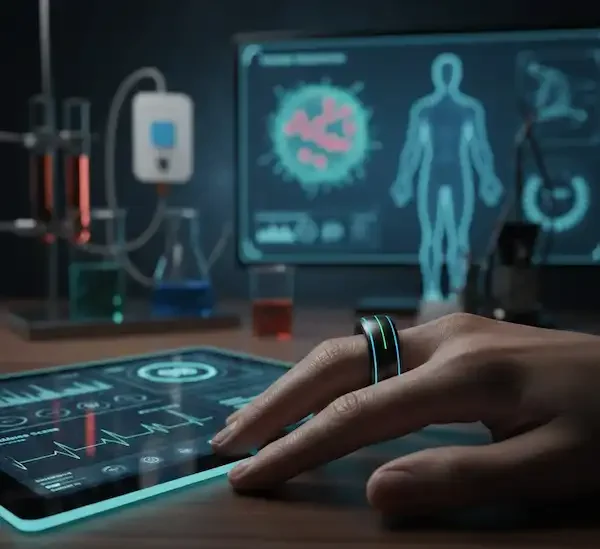
I recently sat down with a hardware consultant for one of the “Big Three” ring manufacturers. The buzz in the industry isn’t just about more sensors; it’s about predictive health. We are moving toward a world where your health optimization ring will ping you at 10:00 AM to say, “Your immune system is struggling; you are likely to show flu symptoms in 48 hours.”
This isn’t science fiction. During the COVID-19 pandemic, researchers at UCSF found that rings could often predict symptoms days before a test came back positive. In 2026, these “Early Warning Systems” are becoming standard in any high-end health optimization ring.
Why Use This Over a Traditional Tracker?
The jump from a smartwatch to a health optimization ring is essentially a transition from “fitness enthusiast” to “biological engineer.” You are choosing to prioritize the internal over the external. You aren’t just counting steps; you are auditing your nervous system. By wearing a health optimization ring, you get a much more accurate picture of your basal body temperature, which is a key indicator of metabolic health.
Furthermore, the form factor matters for consistency. Most people take their watches off to charge daily or because they are uncomfortable during sleep. A health optimization ring stays on for a week at a time, ensuring there are no holes in your longitudinal data.
Frequently Asked Questions
Which finger is best for a health optimization ring?
Most manufacturers recommend the index finger for the highest accuracy. The blood flow is most robust there, and it’s easier for the sensors to maintain a “lock” on the skin. I’ve found the middle finger works well too if your index is between sizes.
Can I wear it while weightlifting?
This is a common “insider” tip: don’t. While the rings are titanium, they can scratch easily against steel barbells. More importantly, they can cause “ring avulsion” (a nasty injury if the ring gets caught). I always slide my health optimization ring into my pocket before a heavy lifting session.
Do I need a subscription?
This is the big divide. Oura requires one for deep insights, while RingConn and Ultrahuman currently do not. If you hate monthly fees, consider that when choosing your health optimization ring.
Is it waterproof?
Yes, almost all high-end rings are rated for at least 50m to 100m. I wear mine in the pool and the sauna without a second thought.
Final Thoughts
The data is only useful if you’re willing to change your habits based on what it tells you. Whether you choose the Oura, Ultrahuman, or RingConn, integrating a health optimization ring into your daily routine is about moving from “feeling” to “knowing.” It’s about the subtle art of biohacking—finding the small, 1% gains that add up to a transformed life.
Additional Helpful Information
What is the best smart ring for athletics – The Best Smart Ring for Athletes: Why Recovery Data Beats Heart Rate Tracking