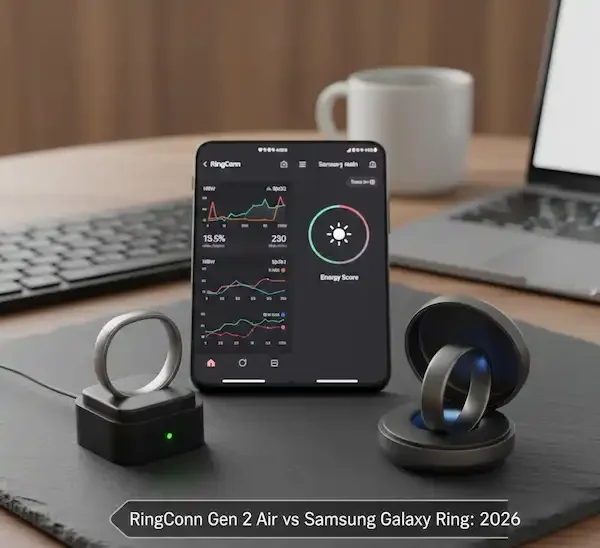
RingConn Gen 2 Air vs Samsung Galaxy Ring: An Actual Comparison
Choosing between the RingConn Gen 2 Air vs Samsung Galaxy Ring isn’t just about picking a piece of jewelry; it’s about choosing an ecosystem that fits your actual life. I’ve spent the last few months swapping these between my fingers, and the reality of living with them is quite different from what the spec sheets suggest.
If you are torn between these two, the first thing you need to check isn’t the battery life—it’s the phone in your pocket. I learned this the hard way when I tried to set up the Samsung on my partner’s iPhone, only to find out it was a “no-go” zone.
The Elephant in the Room: iPhone vs. Android
The most critical takeaway from my time with these rings is compatibility.
- Samsung Galaxy Ring: This is strictly an Android-only affair. If you have an iPhone, the Samsung Galaxy Ring is essentially a very expensive, non-functional band of titanium. As noted in recent Samsung compatibility guides, the company sees this as a “walled garden” play to keep users in their ecosystem. Even within Android, you get the “VIP experience” only if you use a Samsung phone, unlocking features like “Energy Score” and “Find My Ring.”
- RingConn Gen 2 Air: This is what I call the “people’s ring.” It works flawlessly on both iOS and Android. I’ve jumped between my Pixel and my iPhone 15 Pro, and the RingConn app doesn’t skip a beat. It’s one of the few high-end wearables that doesn’t punish you for switching phone brands. In the RingConn Gen 2 Air vs Samsung Galaxy Ring battle, RingConn wins the inclusivity award.
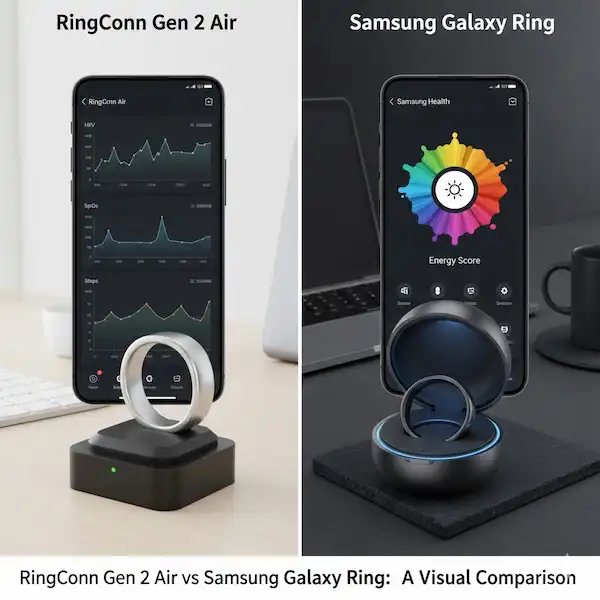
Comparison Table: At a Glance
| Feature | RingConn Gen 2 Air | Samsung Galaxy Ring |
| Material | Premium Stainless Steel | Aerospace-Grade Titanium |
| Weight | 2.5g – 4g | 2.3g – 3g |
| Battery Life | ~10 Days | ~6-7 Days |
| iPhone Support | Yes | No |
| Subscription | None (Free Forever) | None (Free Forever) |
| Unique Feature | Ultra-thin (2mm) | Gesture controls (Double pinch) |
Personal Experience: The “Forgotten” Wearable
I’ve always found smartwatches a bit noisy. They buzz, they glow, and they need to be charged every night. Switching to a ring was supposed to solve that.
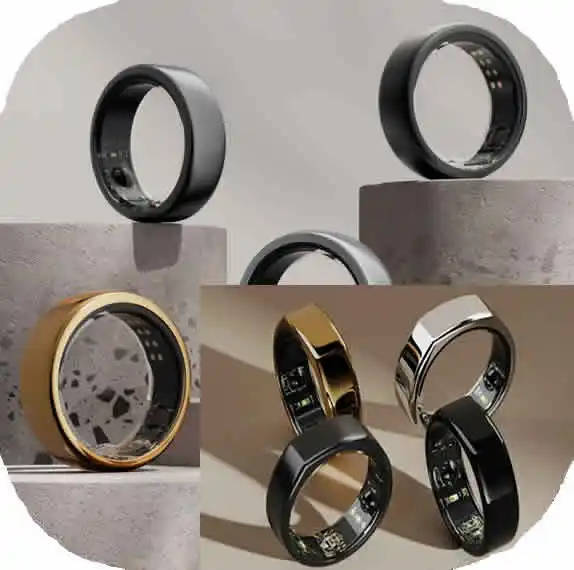
The Samsung Galaxy Ring has this unique concave design. It dips inward, which actually does a great job of hiding scratches. I wore it while moving furniture, and while I felt some “metal-on-metal” anxiety, it came out looking brand new.
However, the RingConn Gen 2 Air blew me away with its thinness. At just 2mm thick, it’s the first smart ring that didn’t make me feel like I was wearing a bulky high school class ring. I’m a writer, and I spend eight hours a day typing. Thick rings usually dig into my adjacent fingers. With the Gen 2 Air, I genuinely forgot I had it on until the app pinged me to tell me I hadn’t moved in three hours. When comparing the RingConn Gen 2 Air vs Samsung Galaxy Ring for pure comfort, the Air feels more like a standard wedding band. Tech experts at PCMag have echoed this, noting that the “squircle” design helps it stay oriented for better sensor contact.
Battery Life: The Weekly Ritual
One of my biggest pet peeves with the Galaxy Ring was the “Sunday Scaries”—that moment I realize I forgot to charge it and it’s at 5%. Samsung gives you about 6 days. It’s fine, but it’s a weekly chore.
The RingConn Gen 2 Air is a different beast. I consistently get 10 days out of it. In the smart ring world, those extra four days are the difference between “gadget maintenance” and “set it and forget it.” RingConn also includes a charging dock, but if you step up to their standard Gen 2 (non-Air), you get a portable case that holds 150 days of charge. In my RingConn Gen 2 Air vs Samsung Galaxy Ring testing, the longevity of the Air made a massive difference during a two-week hiking trip where I didn’t want to carry extra cables.
Sleep and Health: Industry Insider Insights
As someone who has followed health-tech for years, I can tell you that the “magic” isn’t in the sensors—it’s in the algorithms. Both rings use PPG (Photoplethysmography) sensors—those little green and red blinking lights—to measure your blood flow.
- Sleep Tracking: The Galaxy Ring integrates deeply with Samsung Health. If you’re already in that ecosystem, the “Energy Score” feels like a natural extension of your life. It tells you if you’re ready to hit the gym or if you should take a nap.
- The RingConn Edge: Where RingConn surprises everyone is the data transparency. They don’t hide your raw data. You can see your HRV (Heart Rate Variability) and SpO2 (Oxygen levels) charted out with more granularity than Samsung provides. For the data nerds among us, the RingConn Gen 2 Air vs Samsung Galaxy Ring debate leans toward RingConn for raw metrics.
Design and Durability
I noticed something interesting about the materials. Samsung uses titanium, which is incredibly light. RingConn Gen 2 Air uses stainless steel for this specific “Air” model to keep the price down. You’d think the steel would feel heavy, but because they’ve shaved it down to 2mm, it actually feels lighter on the finger than the Samsung.
However, stainless steel can scratch. If you’re a “handy” person who works with tools, the Samsung Galaxy Ring’s concave titanium design is better at protecting those internal sensors. I’ve seen some RingConn Gen 2 Air vs Samsung Galaxy Ring photos online where the RingConn looks a bit “weathered” after a year of heavy lifting. If you want that pristine look, you might prefer the Samsung.
Charging and Cases: The Travel Experience
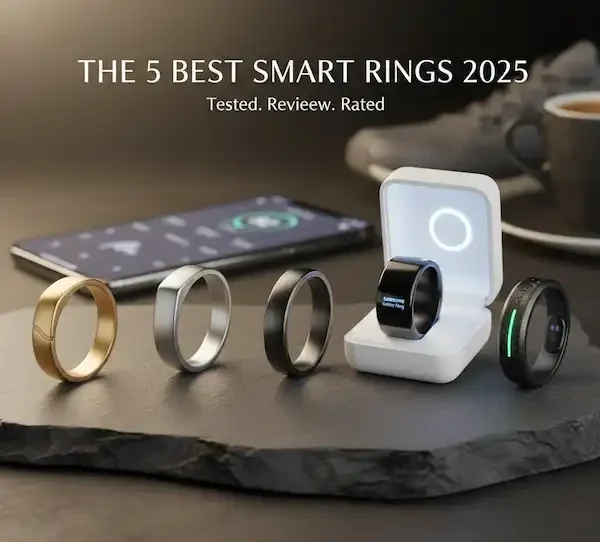
Samsung’s charging case is beautiful. It looks like a high-end jewelry box and has its own internal battery. You can drop the ring in, and it charges while you’re on the move.
The RingConn Gen 2 Air comes with a simple USB-powered dock. It doesn’t have an internal battery. This was a bit of a letdown for me. If you want the portable case, you have to buy it separately or upgrade to the standard Gen 2. In the RingConn Gen 2 Air vs Samsung Galaxy Ring travel test, Samsung wins for the out-of-the-box convenience, but RingConn wins because you only have to use that dock three times a month.
Pricing and Value
Let’s talk money. The Samsung Galaxy Ring launched at roughly $399. The RingConn Gen 2 Air sits much lower at around $199.
When you look at the RingConn Gen 2 Air vs Samsung Galaxy Ring price gap, you have to ask yourself: is the Samsung logo and the “Energy Score” worth an extra $200? For me, the answer was no. The RingConn provides 90% of the same data for 50% of the price. Plus, neither ring requires a subscription, which is a huge relief compared to the Oura Ring. This lack of monthly fees is a growing trend among the best smart rings of 2026.
The “Squircle” Factor
One thing I didn’t expect to matter was the shape. The RingConn Gen 2 Air is a “squircle”—round on the inside, but slightly squared on the outside. This actually helps keep the ring from spinning on your finger. In the RingConn Gen 2 Air vs Samsung Galaxy Ring comparison, this is a major win for accuracy. If a smart ring spins and the sensors aren’t at the bottom of your finger, the data gets messy. The Samsung is perfectly round, and I found myself adjusting it several times a day to keep the little alignment marker in the right spot.
FAQ: Clearing Up the Confusion
Q: Does the RingConn Gen 2 Air require a monthly subscription?
A: No. One of the best things about the RingConn Gen 2 Air vs Samsung Galaxy Ring comparison is that both brands have rejected the subscription model. Your data is yours for free.
Q: Can I swim with these rings?
A: Yes. Both are rated for 100 meters (10 ATM). I’ve worn my RingConn in the pool and the shower with zero issues. Just be careful with soap; it can make the ring slide off!
Q: Is the RingConn Gen 2 Air accurate for fitness?
A: Smart rings, in general, are “activity trackers,” not “fitness trackers.” They are great for steps and heart rate during a walk, but if you’re doing heavy weightlifting, the pressure on the ring can be uncomfortable and the data can lag.
Q: Does the Gen 2 Air have sleep apnea monitoring?
A: No. This is a common point of confusion in the RingConn Gen 2 Air vs Samsung Galaxy Ring debate. As explained on RingConn’s blog, the standard RingConn Gen 2 has sleep apnea monitoring, but the “Air” version sacrificed that sensor to remain the thinnest ring on the market.
Q: How do I know my size?
A: Always use a sizing kit. Your finger size changes throughout the day based on temperature and hydration. I found that I was a size 10 in the morning but needed a size 11 by the evening. Both companies provide kits, and I highly recommend wearing the plastic sizer for at least 24 hours.
Ultimately, the RingConn Gen 2 Air vs Samsung Galaxy Ring choice comes down to how much you value thinness and battery life versus ecosystem integration. For my daily life, the RingConn Gen 2 Air has stayed on my finger longer simply because I don’t have to think about it. It’s a tool that works in the background, exactly how a smart ring should.
Additional Helpful Information
- Read more about other comparisons – Oura Ring vs Samsung Galaxy Ring vs Ultrahuman Ring Air: 2026 Review
- What is the best smart ring for Android? – Best Smart Ring for Android
- Take a look at the RingConn vs Ultrahuman comparison – RingConn Gen 2 vs Ultrahuman Ring Air: A Real-World Longevity Test