RingConn Gen 2 vs Ultrahuman Ring Air: The Real Choice Between Thin Tech and Performance Coaching
I used to be the guy who checked his watch every ten minutes to see if my heart rate was “normal” while sitting on the couch. It was a bit much. Eventually, I realized that if I wanted to actually live my life without a screen constantly chirping at me, I needed something more discreet. That’s how I ended up with a smart ring. But even in 2026, the market for a device like the RingConn Gen 2 vs Ultrahuman Ring Air is a bit of a wild west.
If you are currently weighing up the RingConn Gen 2 vs Ultrahuman Ring Air, you’ve likely realized that these are the two best “no-subscription” options left. I’ve spent the better part of the last six months wearing both—one on each hand—to see which one actually earns its keep. It turns out that while they look similar, the experience of living with them is completely different.
2026 Real-World Longevity Comparison
| Feature | RingConn Gen 2 | Ultrahuman Ring Air |
| Battery Life (Solo) | 10–12 Days (Best in class) | 4–6 Days (Standard) |
| Total Battery (w/ Case) | 150+ Days (Portable case) | ~6 Days (Flat dock only) |
| Medical Features | Sleep Apnea Monitoring (90.7% acc.) | FDA-cleared AFib Detection |
| Thickness / Weight | 2.0 mm / 2.0g (Thinnest/Lightest) | 2.4 mm / 2.4g |
| App Philosophy | Functional & Raw: Clean data display. | Coaching & Insights: Modular “PowerPlugs.” |
| Ecosystem | Standalone health tracker. | Integrates with CGM (M1) & Blood Vision. |
| Durability (Longevity) | High (Aerospace Titanium); few failures. | Moderate; reports of battery degradation. |
| Price (2026 Avg.) | $299 | $349 |
| Subscription | None (Lifetime free) | None (Lifetime free) |
The Physicality: “Squircle” vs. Minimalist Circle
The first thing people ask me is: “Does it feel like a piece of tech or a piece of jewelry?”
The Ultrahuman Ring Air is the purist’s choice. It’s a perfect circle, and at 2.4 grams, it is absurdly light. When I’m typing or cooking, I genuinely forget it’s there. The inner shell is a smooth, hypoallergenic resin that feels like silk against the skin. If you have fingers that swell after a long flight or a salty meal (like mine do), that smoothness is a godsend because it doesn’t “bite” into your skin.
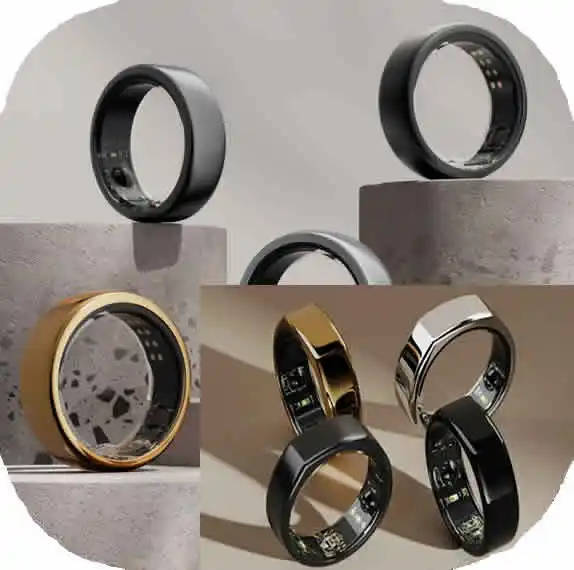
Then we have the RingConn Gen 2. They stuck with their “squircle” design—slightly flattened on the top and bottom. At first, I thought it looked a bit industrial, but there’s a functional reason for it. A smart ring’s sensors need to stay on the underside of your finger to get an accurate pulse. With a perfectly round ring like the Ultrahuman, I’m constantly fidgeting with it to make sure the little alignment notch is pointing down. The RingConn’s shape naturally resists spinning.
Inside the industry, we talk about “stack height”—how far the ring protrudes from your finger. The RingConn Gen 2 is currently among the thinnest on the market at 2.0mm. That 0.4mm difference over the Ultrahuman seems small on paper, but when you’re gripping a barbell or holding a steering wheel, the RingConn feels much more integrated into your hand.
The Battery Battle: The 10-Day King
If there is one area where the RingConn Gen 2 vs Ultrahuman Ring Air comparison becomes an easy win for one side, it’s the power management.
- Ultrahuman Ring Air: I usually get about 5 to 6 days. It’s respectable, but by the evening of day five, I’m checking the app with a bit of “range anxiety.”
- RingConn Gen 2: This thing is a freak of nature. I consistently get 10 to 12 days. I can go on a week-long camping trip and not even think about a charger.
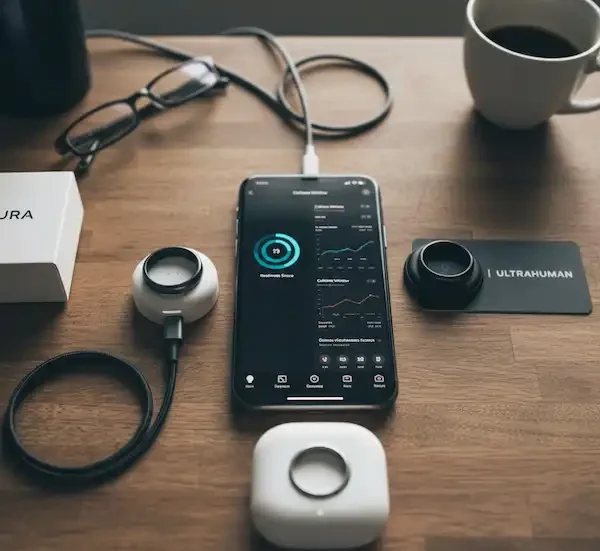
But the real “insider” secret is the charging case. RingConn includes a portable case that looks like a high-end earbud case. It holds enough charge to keep the ring powered for 150 days. When I traveled to Japan last month, I threw the ring in the case for 20 minutes while I showered, and that was it. No cables, no pucks, no hassle. Ultrahuman uses a standard USB-C “puck” charger—it works fine, but it’s one more thing to lose in the abyss of a suitcase.
Health Insights: Sleep Apnea vs. The “PowerPlug” Universe
The way these two rings interpret your body is where you’ll likely make your decision.
RingConn’s Medical Leanings
The RingConn Gen 2 has pivoted hard toward clinical utility. Their big play is Sleep Apnea Monitoring. They’ve put this through rigorous testing, boasting a 90.7% accuracy rate compared to clinical standards.
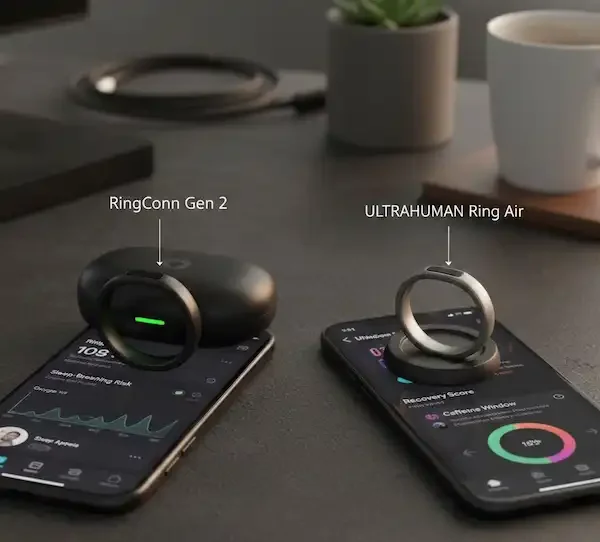
I don’t have diagnosed apnea, but seeing the “Breathing Risk” scores in the RingConn app was eye-opening. It showed me how my oxygen saturation dipped significantly on nights when I was overly stressed or had a late-night drink. It’s not just a graph; it’s a warning system. For anyone who wakes up feeling unrefreshed despite “eight hours” of sleep, this feature is worth the price of admission alone.
Ultrahuman’s Performance Coaching
Ultrahuman feels less like a medical device and more like a high-end coach. Their app uses something called “PowerPlugs”—mini-apps you can toggle on or off.
My favorite is the Caffeine Window. Based on how I slept the night before, the app tells me exactly when my adenosine levels are highest and when I should have my last cup of coffee to ensure I can actually fall asleep by 11 PM. They also have a Phase Alignment tool that pings you to get sunlight at specific times to reset your body clock. It’s very “biohacker” and very actionable.
Living with the Apps: Clean vs. Complex
The RingConn Gen 2 vs Ultrahuman Ring Air experience is largely defined by the software.
The RingConn app is refreshingly simple. It gives you pillars: Sleep, Activity, Stress, and Vitals. There’s no fluff. It doesn’t try to be a social network. It just tells you your heart rate was 56 bpm and your HRV was 45 ms. If you’re the type of person who just wants the data so you can get on with your day, you’ll love it.
The Ultrahuman app, conversely, is a deep dive. It’s filled with indices like the “Movement Index” and “Recovery Score.” It’s designed to be checked multiple times a day. One feature I love is the metabolic tracking where it integrates with continuous glucose monitors (CGMs). It’s not 100% necessary for everyone, but it makes you think twice about that third slice of pizza.
Accuracy: The Reality Check
No smart ring is a medical device, despite what marketing teams want you to believe. However, in the RingConn Gen 2 vs Ultrahuman Ring Air showdown, both are remarkably good at the “resting” metrics.
For Heart Rate (HR) and Heart Rate Variability (HRV) while sleeping, both are within a very tight margin of error compared to a chest strap. Where they struggle is the gym. If you’re doing CrossFit or heavy lifting, the “noise” from your hand movements makes the data pretty messy.
Ultrahuman has a dedicated “Workout Mode” that increases the sensor polling frequency. It’s better than RingConn for tracking a run, but neither will replace a dedicated sports watch for serious athletes. If you’re a runner, you’re still going to want your watch for GPS; the rings are best for the 23 hours of the day when you aren’t training.
Durability: The Scratch Test
Let’s talk about the titanium finish. Both of these rings are tough, but they aren’t indestructible.
The Ultrahuman Ring Air has a beautiful matte finish (especially the “Matte Grey”), but it will show scratches if you’re a weightlifter or a gardener. I’ve found that the scratches on the Ultrahuman tend to “buff out” over time with natural wear, but the first one always hurts.
The RingConn Gen 2 uses a PVD coating that is impressively resilient. After four months of doing dishes and DIY home projects, mine still looks brand new. Because it’s so thin, it almost feels like it should be more fragile, but it’s built like a tiny tank.
The Insider Perspective: Why No Subscription?
As someone who watches this industry closely, I can tell you that the “no subscription” model is the biggest differentiator here. Oura changed the game by charging a monthly fee to see your own data, which opened the door for RingConn and Ultrahuman.
The reason they can afford to do this—for now—is because they are still in the aggressive growth phase. Ultrahuman is building a “metabolic health” ecosystem, while RingConn is leaning into the clinical sleep market. By buying one of these, you are essentially betting on their long-term vision.
Which One Should You Buy?
I’ve had a lot of coffee shop debates over the RingConn Gen 2 vs Ultrahuman Ring Air question. It usually comes down to your personality:
Get the RingConn Gen 2 if:
- You hate charging your tech (12-day battery is a life-changer).
- You’re worried about sleep apnea or respiratory health.
- You want a “set it and forget it” device that doesn’t nag you.
- You travel a lot and love the idea of a 150-day charging case.
Get the Ultrahuman Ring Air if:
- You love data and want to optimize your caffeine and sunlight.
- You want a more “jewelry-like” traditional circular design.
- You use a CGM or want to track your metabolic health more closely.
- You want a “coach” that tells you when to move and when to rest.
Frequently Asked Questions (FAQ)
1. Does the RingConn Gen 2 vs Ultrahuman Ring Air work with Apple Health?
Yes, both rings sync with Apple Health and Google Fit. This is crucial because it allows you to combine your ring’s sleep data with your watch’s workout data for a full picture of your health.
2. Can I shower or swim with these rings?
Absolutely. Both are rated for water resistance (IP68). I’ve taken both into salt water and chlorine pools with zero issues. Just make sure to dry your finger afterward; trapped water can cause skin irritation.
3. Which ring is better for women’s health?
Both rings track skin temperature, which is the key metric for cycle tracking. However, Ultrahuman’s cycle tracking “PowerPlugs” feel slightly more developed and integrated into the daily scores than RingConn’s current offering.
4. How do I get the right size?
Both companies will send you a plastic sizing kit first. Don’t skip this. Your finger size changes throughout the day. Wear the plastic sizer for at least 24 hours. If you’re between sizes, the general advice for the RingConn Gen 2 vs Ultrahuman Ring Air is to size down for RingConn (due to the “squircle” shape) and stay true to size for Ultrahuman.
5. Will my data be private?
Both companies have strong privacy policies and don’t sell your data to insurers. However, since Ultrahuman has a wider ecosystem of “plugins,” you may find yourself opting into more data-sharing agreements than you would with the simpler RingConn app.
Choosing between the RingConn Gen 2 vs Ultrahuman Ring Air isn’t about which ring is “better”—it’s about which one fits your life. If you want a tool that stays out of your way and lasts two weeks, go with RingConn. If you want a performance coach that lives on your finger and helps you optimize every minute of your day, Ultrahuman is the way to go.
Additional Helpful Information
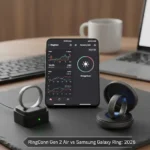
- Take a look at how RingConn compares to Samsung – RingConn Gen 2 Air vs Samsung Galaxy Ring: My Testing Results