The Evolution of Smart Ring AI Health
When I’m out with friends or at a tech conference, someone eventually points at my finger and asks, “Is that one of those smart rings? Does it actually do anything?”
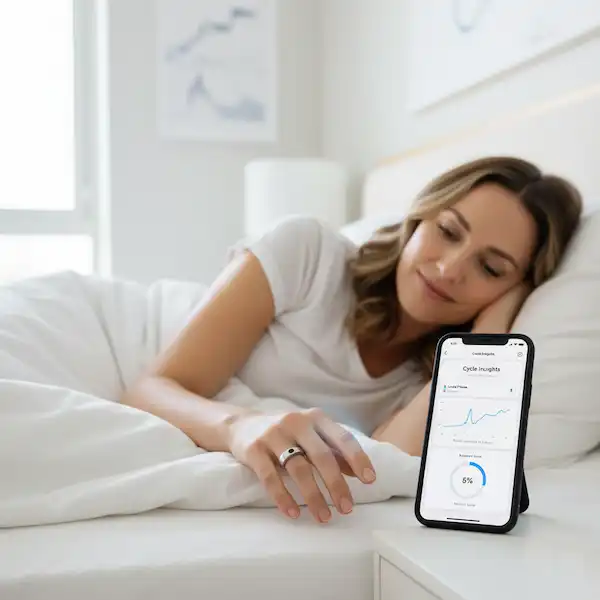
It’s a fair question. For years, these things were just fancy pedometers that lived on your finger. But lately, the game has changed entirely. We’ve moved past the “data dump” era where you just get a bunch of graphs you don’t understand. Now, we’re in the era of the Smart Ring AI Health coach—a shift from mere tracking to actual, usable guidance.
Having tested almost every major ring on the market, from the Oura Ring 4 to the newer entrants like the Samsung Galaxy Ring and the Omni Health Ring, I’ve seen firsthand how these AI “brains” handle our biometrics. Whether you’re on an iPhone or an Android, the experience is becoming less about looking at numbers and more about having a conversation with your own body.
The Real Talk on Smart Ring AI Health
Most people think the “AI” part is just a buzzword. In the industry, we call it “predictive modeling” versus “generative coaching.” The old way was predictive: the ring noticed your heart rate was high and gave you a generic “You might be stressed” notification. The new way—the Smart Ring AI Health approach—is generative. It looks at your heart rate, compares it to the fact that you slept poorly for three days and had a late-night workout, and then actually suggests a specific recovery plan.
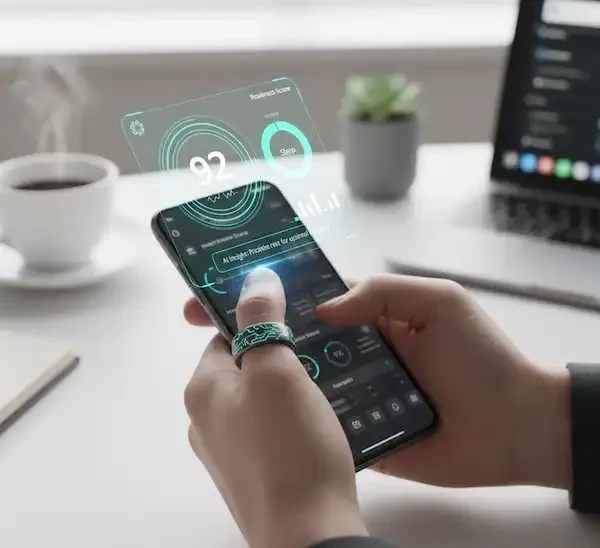
I remember a Tuesday last month when I felt totally fine, but my ring’s AI coach nudged me at 8:00 AM. It didn’t just show me a low “Readiness Score.” It told me that my skin temperature had ticked up by 0.5 degrees and my Heart Rate Variability (HRV) was tanking. “Take it easy today,” it said. Sure enough, by 4:00 PM, I was coming down with a nasty flu. That’s the difference between a tracker and a coach.
Breaking Down the Tech: Android vs. iPhone
One thing people rarely tell you is that the experience can vary depending on your phone.
- iPhone Users: You’re likely living in the Apple Health ecosystem. The high-end AI coaches now sync deeply with Apple HealthKit. This means if you log a heavy lifting session on your Apple Watch but wear your ring for sleep, the Smart Ring AI Health coach sees both. It uses “Large Language Models” (LLMs) to synthesize that data. Some of the newer AI “Advisors” on iOS even allow you to talk to them via Siri or through a dedicated chat interface that feels like texting a personal trainer.
- Android Users: If you’re a Samsung user, the integration is incredibly tight. The Galaxy Ring uses Galaxy AI to crunch your “Energy Score.” For the rest of the Android world, Google Fit and Health Connect are the bridges. I’ve found that Android-based AI coaches tend to be a bit more open with their data—allowing you to see the “why” behind a recommendation a bit more clearly than the often “black box” approach of iOS apps.
Behind the Scenes: The “Insider” Reality of Sensors
Here is a bit of industry secret: the sensors in these rings are often identical across brands. Most use Photoplethysmography (PPG) sensors—those little green and red lights—to see your blood flow. The real “magic” (and where the Smart Ring AI Health keyword really matters) is in the firmware and the cloud processing.
When you wear a ring, the data isn’t processed on the ring itself; it’s too small for a powerful processor. The raw signal is sent to your phone, then to a server. This is where the AI lives. The companies that are winning right now aren’t the ones with the best metal—it’s the ones with the best algorithms. For example, Oura’s “Advisor” and Ultrahuman’s “PowerPlug” systems are essentially massive neural networks that have been trained on millions of nights of sleep data. They aren’t just guessing; they are comparing your finger’s blood flow patterns to a global database of human health.
Why Your Finger is Better Than Your Wrist
I’ve had many conversations with sensor engineers who admit that the wrist is actually a terrible place to measure health. There’s too much bone, hair, and “noise” from moving your arm. Your finger, however, is a highway of capillaries close to the skin.
This is why a Smart Ring AI Health system can detect things a watch might miss. It can see the “pulse wave” more clearly. I’ve noticed that during deep sleep, my ring’s heart rate readings are significantly more consistent than my smartwatch. This higher-quality data is the “fuel” for the AI coach. If the data going in is garbage, the coaching coming out is garbage.
My Personal Routine with an AI Coach
I don’t check my app every five minutes. That’s the quickest way to get “tracker fatigue.” Instead, I use the Smart Ring AI Health features as a morning briefing.
- The Morning Download: I wake up, and while the coffee is brewing, the ring syncs. I look for the “Core Insight.” My AI coach might say, “Your caffeine cutoff was too late yesterday, which cut your REM sleep by 20%.”
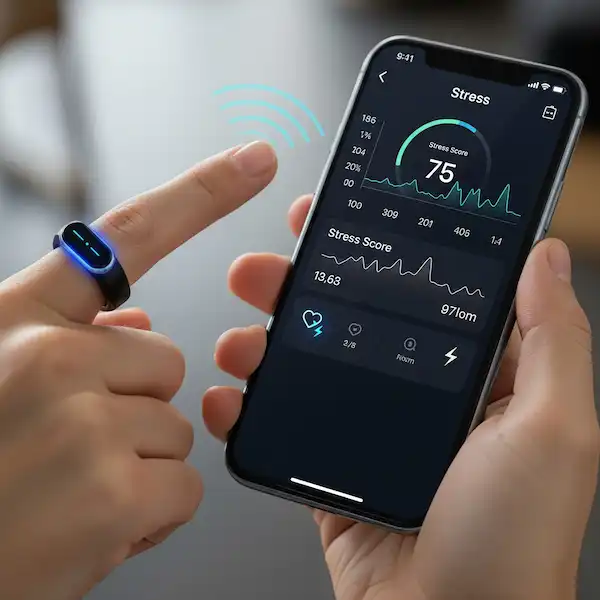
- The Mid-Day Nudge: If I’ve been sitting at my desk for three hours, the AI doesn’t just buzz. It looks at my “Stress Rhythm.” If it sees my stress is peaking, it suggests a three-minute breathing exercise.
- The Evening Wind-Down: This is where the Smart Ring AI Health coach shines. It tells me exactly when my “melatonin window” is opening based on my body temperature trends. This isn’t a fixed time; it shifts every day.
The Subscription Trap and the “Hidden” Costs
Let’s be real: most of these AI coaches aren’t free. You pay $300 to $500 for the ring, and then you often face a $6 to $10 monthly fee. As an insider, I can tell you that these fees are what pay for the massive server costs required to run the AI models.
However, we are seeing a shift. Brands like RingConn and some of the newer Omni models are trying to bake the AI cost into the hardware price. If you hate subscriptions, look for rings that offer “Local AI” processing, though they are currently less “chatty” than the cloud-based ones.
Is It Really “Human” Coaching?
One of the biggest complaints I hear is that AI feels cold. But the latest updates in Smart Ring AI Health technology have introduced “Compassionate AI.”
Instead of saying “You failed your step goal,” the coach might say, “I noticed you had a really long workday and your recovery is low. It’s okay to skip the gym today; let’s focus on a 10-minute walk instead.” This shift from “commander” to “partner” is why people are actually sticking with these devices for years instead of throwing them in a drawer after two months.
Smart Ring AI Health: The Future of Preventive Medicine
I truly believe we are only at the beginning. I recently spoke with a developer who is working on integrating blood glucose trends (non-invasive) into the Smart Ring AI Health ecosystem. Imagine your ring telling you, “That bagel you just ate is going to make you crash in an hour; go for a quick walk to level out your blood sugar.”
We’re moving toward a world where the ring doesn’t just tell you that you’re sick, but predicts it days in advance by watching the subtle “drift” in your resting heart rate. This proactive stance is the ultimate goal of the Smart Ring AI Health movement.
Helpful Tips for New Users
If you’re just starting out, don’t get overwhelmed.
- Pick the right finger: The index or middle finger usually gives the best signal for the sensors.
- Give it two weeks: The AI needs time to learn your “baseline.” The first week of data is usually just the ring getting to know you.
- Be honest with the app: Most AI coaches allow you to “tag” events—like “late meal” or “alcohol.” The more you tag, the smarter the Smart Ring AI Health coach becomes.
Additional Thoughts
In my years of wearing these gadgets, I’ve realized that the best technology is the kind you forget you’re wearing. A ring is small, discreet, and—thanks to the new Smart Ring AI Health capabilities—it finally provides the “so what?” that has been missing from wearables for a decade.
Frequently Asked Questions
Does the AI coach work without an internet connection? Most of the “coaching” happens in the cloud. While the ring will still collect data offline, you usually won’t get those deep, conversational insights until your phone connects to the internet and sends the data to the AI servers.
Is my health data safe from the AI companies? This is a hot topic in the industry. Most reputable brands use “end-to-end encryption.” The AI “sees” your patterns to coach you, but your name and identity are usually stripped away during the processing. Always check the privacy policy for mentions of “third-party data sharing.”
Can a Smart Ring AI Health coach replace a doctor? Absolutely not. These are wellness tools, not diagnostic medical devices. They are great at showing trends, but if your ring tells you something is wrong, your next stop should always be a human professional.
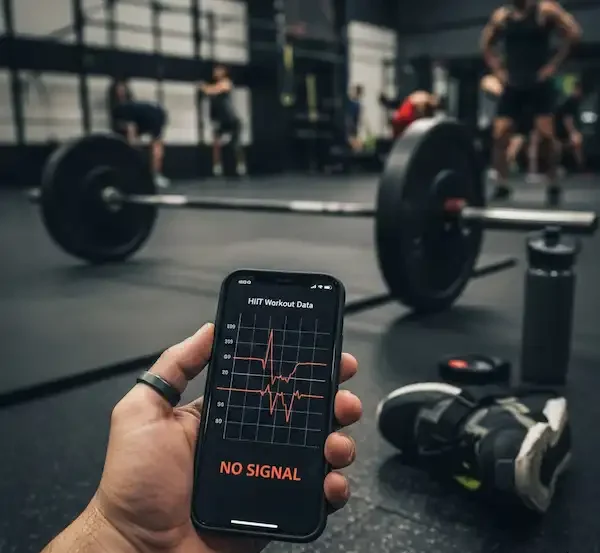
How does the AI handle “noisy” data, like when I’m washing dishes? The AI uses “motion masking.” It looks at the accelerometer data (which tracks movement) and the PPG data (which tracks pulse) simultaneously. If it sees a lot of movement, it “discounts” that heart rate data so it doesn’t skew your daily averages.
Which is better: Oura, Samsung, or a generic AI ring? It depends on your ecosystem. If you have a Samsung phone, the Galaxy Ring is a no-brainer. If you want the most mature AI coaching, Oura’s “Advisor” is currently the gold standard. If you want a one-time payment, look for the newer “no-subscription” rings entering the market.
It’s not about being a “superhuman” or tracking every calorie. It’s about having a quiet, intelligent partner that knows when you need a push and, more importantly, when you need a rest. If you’re tired of bulky watches and confusing charts, the world of AI-driven rings is a breath of fresh air.
Just remember: the ring provides the map, but you still have to do the walking.
Additional Helpful Links
- Read more about using a smart ring to monitor your health – Smart Ring Health Monitor – Best Proactive Health Tool
Authoritative External Links:
- Heart Rate Variability (HRV) Explained: Harvard Health Publishing – Heart rate variability: A new way to track well-being (You might need to search for this article on the Harvard Health website as direct linking can be tricky)
- The Importance of Sleep: National Sleep Foundation
- Understanding AI in Wearables: MIT Technology Review (Search for articles related to AI and wearables)
- The Science of PPG Sensors in Wearables – A deep dive into how light-based sensors actually work.
- How Large Language Models are Changing Healthcare – Understanding the “brain” behind the AI coach.
- The Role of HRV in Stress Management – Why your ring focuses so much on this specific metric.
- Data Privacy in the Age of AI Wearables – A look at the legal and ethical side of health data.