
My Deep Dive into Smart Ring Blood Pressure Tracking
Let’s be honest, those bulky arm cuffs are a pain. Every time I strap one on—especially when I’m running late or stressed—I swear the reading jumps 10 points. I’ve always dreamed of a seamless, invisible way to keep tabs on my heart health. That’s why, when smart rings started popping up, my immediate question wasn’t, “Can it track my sleep?” but “Can it finally ditch the cuff?” Learn more about Smart Ring Blood Pressure Tracking.
The world of smart rings promising blood pressure tracking is fascinating, but it’s also a little bit Wild West right now. As I’ve followed this technology, I’ve realized we need to separate the genuine breakthroughs from the hopeful hype.
The Honest Truth: It’s Not Quite Cuff-Free Magic (Yet)
Before we get into the cool gadgets, let’s talk brass tacks. Measuring blood pressure accurately requires force—that inflation and deflation you feel on your arm. A little ring sitting innocently on your finger just can’t replicate that force.
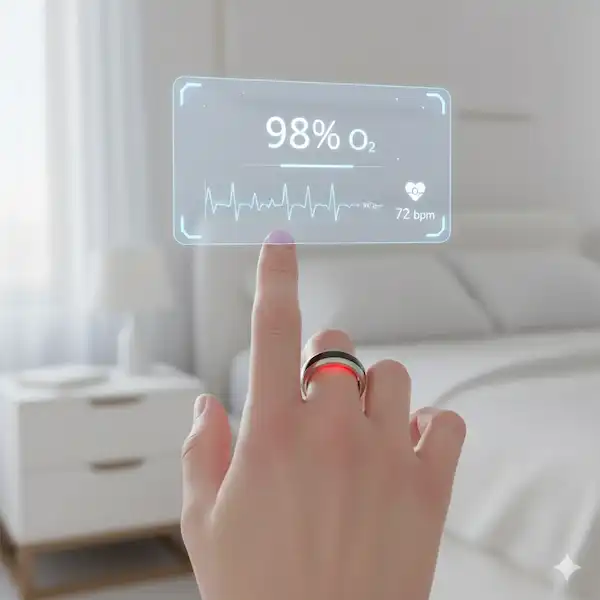
The rings that do offer a blood pressure metric are doing some serious digital gymnastics. They use the same light-based sensor (called PPG) that tracks your heart rate, but they’re using complex algorithms to analyze the Pulse Wave Velocity—basically, how quickly your pulse travels through your body. Faster pulse waves often correlate with higher, stiffer blood pressure.
My takeaway? These readings are generally educated estimations, not certified medical facts. Think of them as a friendly nudge or a way to spot major trends, not a green light to ignore your doctor.
My Personal Ring Rundown: Who’s Trying the Hardest?
I’ve been tracking the major players in the smart ring space, and a few are clearly betting big on Smart Ring Blood Pressure Tracking.
1. The Movano Ring Evie: The FDA Hopeful
The Evie ring caught my eye because it wasn’t just another tech gadget—it was aiming straight for the medical market, specifically seeking FDA clearance for some of its metrics. This tells me they are serious about accuracy.
I see the Evie as a potential game-changer. While their BP feature is still in the developmental/clearance pipeline, their approach—working with the medical establishment—gives me confidence. They’re trying to prove their estimation model works, which is exactly what we need. It reminds me of the early days of smartwatches getting ECG clearance; someone has to lead the charge.
2. Samsung’s Rumored Galaxy Ring: A Smartwatch Transplant
Samsung already has blood pressure functionality baked into their smartwatches (though it often requires monthly calibration with a cuff). So, the speculation around a Galaxy Ring is huge. If anyone has the sensor technology and the existing data sets to shrink this feature down to a ring, it’s them.
If this ring ever materializes, I anticipate it will be powerful, but probably follow the same calibration rules as their watches. You might get great accuracy, but you still need that monthly date with the cuff.
3. Oura Ring: The Indirect Genius
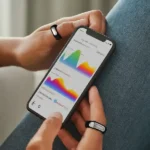
My personal Oura Ring doesn’t claim to measure blood pressure, and I actually appreciate their honesty. But here’s where the personal data gets powerful:
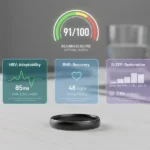
- HRV (Heart Rate Variability): If my Oura tells me my HRV has tanked (meaning I’m stressed or tired), I know my body is likely under cardiovascular strain, which often means my BP is higher than normal.
- Resting Heart Rate (RHR): The night I ate too late, had a drink, and slept poorly, my RHR often jumps. It’s a huge clue that my circulatory system had to work harder.
Oura gives me the context for my blood pressure, even if it doesn’t give me the number. Sometimes, the context is more useful than a single snapshot number!
What I’ve Learned About Reading the Data
If you decide to try a ring that claims Smart Ring Blood Pressure Tracking, here’s my advice from living with these devices:
Accuracy is a Journey: We are at the beginning of this tech. It will get better, but treat current readings with a healthy dose of skepticism until there’s a gold stamp (like FDA clearance).
Look for Trends, Not Snapshots: Don’t obsess over one reading. If your ring consistently shows your estimated systolic pressure climbing from $120$ to $135$ over two weeks, that’s the signal you need to act on—schedule a doctor’s visit and use the traditional cuff.
Calibration is Key (and Annoying): If the ring needs to be calibrated against a traditional cuff, do it religiously. The algorithm is trying to learn your body’s unique pulse profile. If you skip calibration, the estimation accuracy falls off a cliff.
Understanding the Data: What to Look For
When evaluating Smart Ring Blood Pressure Tracking, consider these factors:
- FDA Clearance/Medical Certification: This is the gold standard for accuracy and reliability. Rings with medical clearance have undergone rigorous testing.
- Calibration Requirements: Does the ring need regular calibration with a traditional blood pressure cuff? This can impact convenience.
- Methodology: How does the ring actually measure or estimate blood pressure? Understand the underlying technology.
- Peer-Reviewed Studies: Has the manufacturer published data supporting the accuracy of their blood pressure tracking in scientific journals?
- User Reviews: While not a substitute for scientific validation, user experiences can offer practical insights.
Chart: Smart Ring Blood Pressure Tracking Status
| Smart Ring Model | Direct Blood Pressure Measurement? | Status/Notes |
| Movano Ring Evie | No (currently an estimate) | Pursuing FDA clearance for various metrics, including blood pressure. |
| Samsung Galaxy Ring | Anticipated | Rumored. Samsung’s expertise in smartwatches suggests likely inclusion. |
| Oura Ring | No | Provides strong indirect cardiovascular insights (HRV, RHR). |
| Circular Ring | No | Future potential for integration as technology evolves. |
| Other emerging rings | Varies | Many are in research or development, with varying levels of claimed accuracy. |
Additional Helpful Content: The Future of Smart Ring Blood Pressure Tracking
The landscape of Smart Ring Blood Pressure Tracking technology is evolving rapidly. Here’s what we can expect:
- Improved Accuracy: As sensor technology and algorithms advance, we anticipate more accurate and reliable blood pressure readings from smart rings, potentially reaching medical-grade levels.
- Non-Invasive Continuous Monitoring: The ultimate goal is continuous, passive blood pressure monitoring without the need for periodic cuff measurements, offering invaluable data for personalized health management.
- Integration with Telehealth: Smart rings could play a significant role in remote patient monitoring, allowing healthcare providers to track blood pressure trends and intervene proactively.
- Early Detection: Continuous monitoring could aid in the early detection of hypertension and other cardiovascular issues, leading to better outcomes.
FAQ from My Desk to Yours
Q: I heard about a ring that was “medically certified.” Is that true? A: Some rings may have medical certification for ECG (Electrical Heart Signal) or SpO2 (Blood Oxygen), but that doesn’t automatically cover blood pressure. Always check the fine print for the specific metric you care about.
Q: Why is BP so much harder to track than heart rate? A: Heart rate is just the number of beats. Blood pressure is the force exerted by the blood on the vessel walls. One is counting; the other is measuring force/resistance, which is mechanically much more challenging to do passively on your finger.
Q: Should I wait to buy a ring until they are perfect? A: It depends on your goal. If you want cutting-edge health tracking (sleep, activity, temperature) now, buy one. If the only reason you want a ring is for perfect, cuff-accurate BP tracking, you might want to wait a year or two for the technology and regulations to fully catch up.
My Takeaway and Next Steps
I’m excited about the future. I believe continuous, non-invasive blood pressure monitoring is coming, and the Smart Ring Blood Pressure Tracking is the perfect form factor for it—discreet, worn 24/7, and close to a major artery.
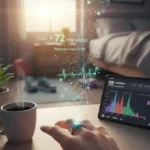
Until then, I’m using my ring as a powerful contextual health tool. It alerts me when my heart is stressed, my sleep is poor, or my body temperature is off. If I see those negative trends, I know it’s time to pull out the reliable cuff and call my doctor.
Additional Helpful Links
- Explore HRV and RHR readiness of smart rings – Smart Ring Readiness: HRV, RHR & Sleep
- Learn about smart ring blood glucose monitoring – Smart Ring Blood Glucose Monitoring: Fact vs. Fiction
External Links for Authoritative Sources:
- American Heart Association: https://www.heart.org/
- World Health Organization (WHO): https://www.who.int/news-room/fact-sheets/detail/hypertension
- U.S. Food and Drug Administration (FDA): https://www.fda.gov/medical-devices/digital-health-center-excellence/digital-health-technologies