The Real-World Truth About Smart Ring Durability: Titanium vs. Steel vs. Ceramic
I’ve spent the better part of the last three years with a rotating cast of smart rings on my fingers. My friends joke that I’m more “Borg” than human at this point, but testing these things has taught me one thing: the spec sheet rarely tells the whole story. When you’re choosing Smart ring durability between titanium, stainless steel, and ceramic, you’re not just picking a look. You’re picking how much you have to baby your tech.
Smart ring durability is the single most important factor for a device meant to be worn 24/7. Whether you’re an Android die-hard or an iPhone minimalist, your ring is going to hit doorframes, scrape against gym bars, and take a bath in dishwater. Here is the insider breakdown of how these materials actually hold up in the wild, based on my own trial and error—and a few broken devices along the way.
The Heavyweight Contender: Stainless Steel
Most of the “budget” smart rings you find on the market—and even some legacy models—rely on stainless steel. It’s the old reliable of the jewelry world, but in the context of wearable tech, it has some quirks you need to know about.
The Hands-On Experience
The first thing you notice with a steel ring is the “presence.” It’s got a density that titanium lacks. If you like the feeling of a traditional wedding band, steel feels right. I wore a steel-cased ring during a cross-country move last summer. By the time I’d unloaded the truck, the bottom of the band looked like it had been through a rock tumbler.
There’s something about the way steel interacts with other metals that feels “honest.” When I’m working in the garden or handling tools, I can feel the ring resisting the pressure. However, it’s a heat magnet. If you’re grilling or sitting by a campfire, you’ll feel that steel ring warm up significantly faster than its titanium counterparts.
The Insider Secret
Here’s what the brands don’t always highlight: stainless steel is tough, but it’s “soft” in the world of high-end metals. Most smart rings use 316L surgical-grade steel. It’s incredibly resistant to corrosion (great for sweat and saltwater), but it will pick up “micro-scratches” within days. Over a year, those scratches blend into a patina. If you’re a perfectionist who wants a mirror finish forever, steel might drive you crazy. However, from a structural standpoint, it’s nearly impossible to crush or crack.
In the industry, we often say steel is for the “set it and forget it” crowd who doesn’t mind a bit of character on their gear. It’s also the material most likely to cause a reaction if you have a very specific nickel allergy, though the surgical grade usually mitigates this.
The Gold Standard: Titanium
Titanium is the current darling of the industry. It’s what Samsung uses for the Galaxy Ring and what Oura uses for the majority of the Gen 3 and Gen 4 lineups.
The Hands-On Experience
The magic of titanium is the weight—or lack thereof. When I switched from a steel ring to a titanium one, I genuinely thought the box was empty. For sleep tracking, titanium is the undisputed king. You simply forget it’s there, which is exactly what you want when your hand is tucked under your pillow.
I took a titanium ring on a week-long backpacking trip in the Sierras. It survived granite scrambles, icy stream dunks, and the general grime of the trail. The most impressive part? Even when my fingers swelled from the altitude, the lightness of the material meant it didn’t feel like a vice grip on my knuckle.
The Insider Secret
There’s a common misconception that titanium doesn’t scratch. It absolutely does. In fact, raw titanium is quite prone to surface scuffs. However, most high-end titanium rings use a PVD (Physical Vapor Deposition) or DLC (Diamond-Like Carbon) coating. As an industry insider, I can tell you that the Smart Ring Durability of a titanium ring often comes down to the quality of this coating rather than the metal itself.
A cheap PVD job will flake off, revealing the silver metal underneath. A high-quality DLC coating, like on the Oura Stealth or the high-end Ultrahuman variants, is incredibly resilient. It bonds to the metal at a molecular level. If you see a ring advertised as “scratch-proof” titanium, check if it’s Grade 5 (aerospace grade) or Grade 2 (commercially pure). Grade 5 is significantly harder and is what you want for long-term wear.
The Dark Horse: Zirconia Ceramic
Ceramic rings are the outliers. They look like glass but act like stone. Brands like Ultrahuman and certain Oura variants have leaned into this material for its distinct aesthetic and its “invisible” tech properties.
The Hands-On Experience
Ceramic feels “warm” compared to metal. It doesn’t have that initial bite of cold when you put it on in the morning. It’s also the most scratch-resistant material I’ve ever worn. I’ve taken a ceramic ring and purposefully rubbed it against a brick wall (don’t ask why, it was a long Tuesday), and it came out looking brand new. The shine is permanent. It has a depth to the color that metal just can’t replicate.
The Insider Secret
Here is the catch: ceramic is brittle. While it won’t scratch, it can shatter. I learned this the hard way when I dropped my ring on a porcelain tile bathroom floor. While a titanium ring would have just bounced and maybe gotten a tiny ding, the ceramic ring developed a hairline fracture.
Another insider tip: ceramic is technically the best material for signal transparency. Because it’s a non-conductive material, the Bluetooth and NFC antennas inside don’t have to work as hard to push a signal through the shell. This can, in some designs, lead to slightly better battery life, though the difference is usually negligible for the end user.
Comparison Table: At a Glance
| Feature | Stainless Steel | Titanium | Zirconia Ceramic |
| Weight | Heavy/Substantial | Ultra-Light | Medium-Light |
| Scratch Resistance | Moderate (will patina) | High (coating dependent) | Near-Immune |
| Impact Resistance | Extremely High | Extremely High | Low (can chip/crack) |
| Skin Sensitivity | Possible Nickel Traces | Hypoallergenic | Hypoallergenic |
| Signal Transparency | Low | Low | High |
| Typical Price | $ – $$ | $$$ | $$-$$$ |
Android vs. iPhone: Does Material Matter?
While the material doesn’t change how the Bluetooth signal travels, the ecosystem does change how you interact with the ring and how it survives your daily routine.
- Android Users: If you’re using a Samsung Galaxy Ring (Titanium), the integration with Health Connect is seamless. The durability of the titanium shell is built for the “Active” lifestyle Samsung promotes. Many Android users are also “power users” who might be tinkering with hardware or working in more rugged environments. For them, the impact resistance of titanium is a safety net.
- iPhone Users: Most iOS users gravitate toward Oura. Since Oura offers both Titanium and Ceramic finishes, you have to choose between the “unbreakable” nature of titanium or the “unscratchable” nature of ceramic. If you’re already in the Apple ecosystem, you likely appreciate the “fit and finish” of your devices. Ceramic matches the aesthetic of a high-end iPhone perfectly, but be warned: it won’t survive a drop on a marble countertop as well as your phone might.
In my experience, if you use an Apple Watch and a smart ring simultaneously (the “double-wristing” of the finger world), titanium is better because it won’t scratch the casing of your watch if they accidentally clink together. I’ve ruined a perfectly good aluminum Apple Watch finish because a ceramic ring rubbed against it during a workout.
Deep Dive: The Science of Coatings
When we discuss Smart Ring Durability, we have to talk about how these things are colored. Most smart rings start as a silver-colored metal. To get that sleek black, gold, or rose gold look, manufacturers use a process called Physical Vapor Deposition (PVD).
I once visited a factory where these coatings were applied. It’s a vacuum chamber where the coating material is evaporated and then condensed onto the rings. If the surface of the ring isn’t perfectly clean, the coating won’t stick. This is why you see some users complaining that their black ring is “peeling.” It’s not the metal; it’s a failure in the PVD process.
DLC (Diamond-Like Carbon) is a premium version of this. It’s much harder and more expensive to apply. If a ring offers a “Stealth” or “Matte” finish, it’s often a DLC coating. In my three years of testing, DLC-coated titanium is the only thing that has truly stood up to the “keys in the pocket” test without showing a single mark.
Environmental Stress: Beyond the Scratches
Smart ring durability isn’t just about hard surfaces. It’s about chemistry.
Saltwater and Chlorine
I spend a lot of time in the ocean. I’ve found that stainless steel, even surgical grade, can develop tiny pits if you don’t rinse it with fresh water after a swim. Titanium is essentially immune to this. Ceramic is also great in water, but the salt can sometimes get trapped in the sensor grooves, leading to skin irritation if you don’t clean it out.
Heat and Cold
I’ve worn smart rings in Finnish saunas and during Colorado winters. Steel gets hot—uncomfortably so. Titanium is a poor thermal conductor, meaning it stays closer to your body temperature regardless of the environment. This is a huge comfort factor that people often overlook when talking about Smart Ring Durability. If the ring gets too hot, the internal battery can degrade faster. Titanium provides a better thermal buffer for the delicate lithium-ion cells inside.
The Invisible Killer: Poting and Resin
When we talk about Smart Ring Durability, we’re usually talking about the outer shell. But the real “death” of a smart ring usually happens internally.
Inside that metal or ceramic exterior, the electronics are encased in a medical-grade resin. This is called “potting.” It’s what makes the ring waterproof. However, if the outer shell expands or contracts too much (which can happen with cheap steel alloys in extreme heat), it can put pressure on this resin. If the resin cracks, water gets to the circuit board, and your $300 investment becomes a paperweight.
Titanium has a very low coefficient of thermal expansion. This means it stays stable in both the sauna and the snow, protecting the delicate sensors inside better than almost any other material. This is why the pros usually recommend titanium for anyone living in extreme climates or those who frequent the gym.
The Gym Factor: A Cautionary Tale
I get asked this all the time: “Can I wear my ring while lifting weights?”
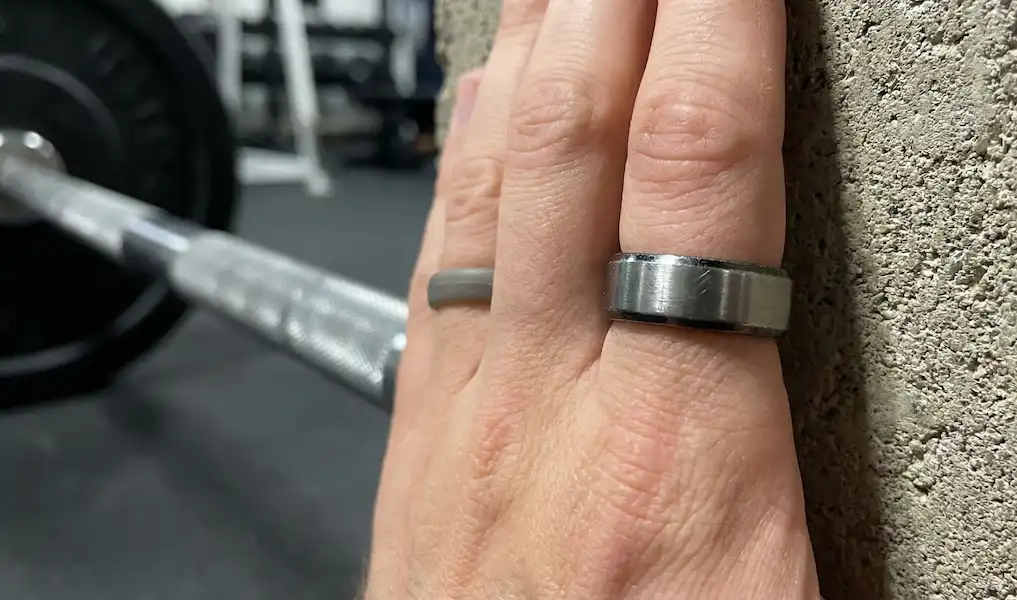
My answer is always a hard “No.” I once tried a heavy deadlift session with a steel smart ring. Not only did the knurling on the bar chew up the finish of the ring, but the pressure of the bar caused the ring to dig into my finger, leading to a nasty bruise.
More importantly, Smart Ring Durability is tested against “average” daily use. It is not tested against 300 pounds of steel being crushed against it. If you’re a serious lifter, take the ring off. It’s better to lose twenty minutes of heart rate data than to lose a $400 device or, worse, injure your finger. If you must track your workout, wear a silicone sleeve over the ring, but even then, you’re risking the internal electronics.
My Personal Recommendation
If I’m buying a ring for myself today, I’m picking Titanium.
I’m a guy who fixes his own bike, plays fetch with a dog who has a very hard mouth, and spends way too much time outdoors. Steel gets too beat up, and I’ve already broken one ceramic ring. Titanium is the “set it and forget it” material. It develops a few “battle scars” over the years—tiny silver lines on a black finish—but it never fails structurally.
There’s also a psychological component. When you know your device is tough, you use it more naturally. You don’t hesitate to reach into a car engine or wash the dishes. That’s the goal of a wearable: it should supplement your life, not dictate how you move.
An Additional Word
Choosing the right material is about matching the tech to your lifestyle. If you’re a desk worker who wants a shiny, pristine piece of jewelry that sparks conversation, go Ceramic. If you’re on a budget and want to see if the smart ring life is for you without a massive upfront investment, go Steel.
But if you want a piece of technology that will survive five years of life’s chaos—from hiking trails to kitchen mishaps—Titanium is the only real choice. The Smart Ring Durability of your device is the bridge between a gadget and a life companion. I’ve seen these devices evolve from plastic toys to aerospace-grade tools, and the shift to high-end metals has made all the difference.
Whether you’re syncing data to your Google Fit or Apple Health, the hardware on your finger is what makes it all possible. Treat it well, pick the right material for your daily grind, and it’ll tell you more about yourself than you ever thought possible. Don’t let a scratched finish or a cracked shell get in the way of your data. Stay active, stay informed, and pick a ring that can keep up with you.
Insider Tip: Buying Used
If you’re looking at the used market, always ask for a close-up photo of the inner sensors. While the outer shell’s Smart Ring Durability is what we see, the inner surface is where the magic happens. Look for scratches over the LED windows. If those are scratched, the data quality will be compromised, regardless of how tough the titanium or steel exterior looks.
In the end, we’re at a point where the hardware is finally catching up to our expectations. A smart ring isn’t just a sensor; it’s a piece of jewelry you’re trusting with your health data. Make sure the “house” you build that data in is made of the right stuff. Personally, I’m sticking with my matte black titanium. It’s got a few nicks from a car repair last month, but every time I look at it, I’m reminded that it’s built to last.
Expanding the Horizon: Future Materials
There is some talk in the industry about liquid metal and even carbon fiber composites for future rings. While these sound cool, they currently lack the proven track record of titanium and ceramic. Liquid metal, for instance, is incredibly strong but can be difficult to cast for complex electronics. For now, the “big three”—steel, titanium, and ceramic—remain the gold standard for anyone concerned with Smart Ring Durability.
As you navigate the options for your next Android or iPhone companion, remember that the best ring is the one you don’t have to think about. It should be an extension of you, surviving your showers, your workouts, and your sleep without a second thought. That is the true definition of durability.
Whether you’re looking for heart rate variability (HRV) data or just want a better way to track your steps, the physical integrity of your ring is the foundation. Choose wisely, and you’ll have a health partner for years to come.
FAQ: Smart Ring Durability
How long does the average smart ring last?
Most users see a 2-to-3-year lifespan. This isn’t because of the metal shell, but because the tiny lithium-ion batteries eventually lose their capacity. The Smart Ring Durability of the exterior will likely outlast the battery inside.
Is titanium better for sensitive skin?
Yes, 100%. Medical-grade titanium is the same stuff they use for hip replacements and dental implants. If you have a nickel allergy or general skin sensitivity, avoid cheap stainless steel rings and stick to titanium or ceramic.
How do I clean a scratched ring?
For raw stainless steel, a jewelry polishing cloth can work wonders. For coated titanium or ceramic, just use mild soap and water. Never use abrasive cleaners or “magic erasers” on a coated ring, or you’ll rub the color right off and ruin the Smart Ring Durability of the finish.
Will the color fade over time?
On ceramic, the color is baked into the material, so it won’t fade or wear off. On titanium and steel, the color is a surface coating. Silver/Natural finishes are the most durable because there’s no coating to scratch off. Gold and Rose Gold finishes are often the most delicate.
Are these rings waterproof for diving?
Most are rated for 50m to 100m. This is fine for swimming and snorkeling. However, high-pressure water (like hitting the water during a high dive) can exceed these limits. Always check the official IP ratings before taking your ring into deep water.
Can I wear it in a hot tub?
Generally, yes. But keep in mind that bromine and chlorine are harsh chemicals. Over years of exposure, they can potentially degrade the seals around the sensors. I always suggest rinsing the ring with fresh water after a soak.
What happens if the internal resin cracks?
If the internal potting fails, you’ll likely notice the battery draining rapidly or the sensors providing erratic data. At that point, the ring is no longer waterproof. This is often covered under warranty if it’s a manufacturing defect, but not if you’ve crushed the ring.
Additional Helpful Links
- Here are some details about sizing for your smart ring – Smart Ring Sizing Kit: Step-by-Step Guide for Perfect Fit
- Learn about smart ring gesture control – Smart Ring Gesture Control: Review, Setup & Supported Rings
For more information on the technical side of these materials, you can check out ASM International’s guide to medical-grade metals or the Jewelry Vigilance Committee for standards on material claims. For general electronics durability, the IEEE often has great papers on wearable sensor longevity.