Smart Rings for Fertility & Advanced Women’s Health Tracking
In an era where technology seamlessly integrates into our daily lives, smart rings have emerged as a discreet yet powerful tool for health monitoring, especially for women. Beyond step counts and sleep analysis, these compact wearables are revolutionizing fertility awareness, menstrual cycle tracking, and even providing insights during pregnancy. This article delves into the fascinating world of smart ring technology for women’s health, focusing on temperature-based fertility tracking, app integrations, and its potential for advanced health insights.
The Science Behind Smart Ring Fertility Tracking
The core of smart ring fertility tracking lies in its ability to accurately measure skin temperature, a proxy for basal body temperature (BBT). BBT is your body’s lowest resting temperature, and it subtly shifts throughout your menstrual cycle due to hormonal fluctuations.
- Before Ovulation: Estrogen is dominant, and BBT is generally lower.
- After Ovulation: Progesterone rises, causing a sustained increase in BBT. This temperature shift confirms that ovulation has occurred.
Traditionally, BBT has been measured orally with a thermometer first thing in the morning. Smart rings automate this process, taking continuous temperature readings throughout the night, often with greater precision and consistency than manual methods.
Example: How a Smart Ring Detects Ovulation Imagine your overnight temperature graph. Before ovulation, your baseline might be around 97.4°F (36.3°C). After ovulation, your ring detects a sustained shift, perhaps to 97.9°F (36.6°C) or higher, for at least three consecutive days. This clear rise signals that ovulation has passed, helping to identify your fertile window retrospectively.
Accuracy of Temperature Data for Fertility
The accuracy of Smart ring fertility tracking in detecting temperature shifts for smart ring fertility tracking is a key concern for users. Devices like the Oura Ring have undergone rigorous validation studies, demonstrating their capability to measure skin temperature with a high degree of precision.
- Continuous Monitoring: Unlike a single morning measurement, smart rings provide a more complete temperature profile, reducing the impact of external factors like room temperature or disturbed sleep.
- Algorithmic Analysis: Sophisticated algorithms analyze temperature trends, identifying subtle shifts that might be missed by the naked eye, leading to more reliable ovulation detection.
- Consistency: The ring is worn consistently on the finger, ensuring the measurement site remains stable, contributing to data reliability.
Chart Example: Typical BBT Curve During a Menstrual Cycle
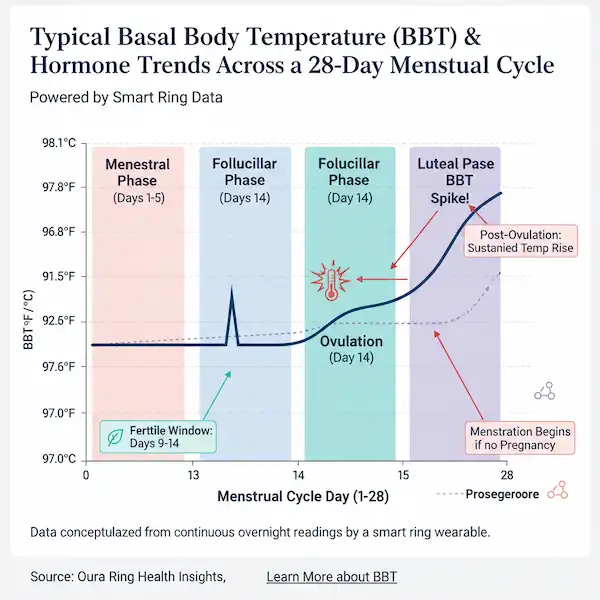
The image above illustrates a typical Basal Body Temperature (BBT) and hormone trends across a 28-day menstrual cycle, conceptualized from continuous overnight readings by a smart ring wearable. It highlights the menestral, follicular, ovulatory, and luteal phases, along with the corresponding temperature shifts.
Integrations with Fertility Apps: Natural Cycles & Beyond
The true power of smart rings for smart ring fertility tracking is often unlocked through seamless integration with dedicated fertility apps. Natural Cycles is a prime example, being the first FDA-cleared birth control app that utilizes BBT.
- How it Works with Natural Cycles: When paired with a smart ring like the Oura Ring, Natural Cycles automatically receives your overnight temperature data. The app’s algorithm analyzes this data, along with other inputted information (like period start dates), to identify your unique fertile window and provide daily “Green Day” (not fertile) or “Red Day” (fertile) guidance.
- Reduced User Burden: This integration eliminates the need for manual temperature taking and logging, making fertility awareness methods significantly more convenient and less prone to user error.
- Personalized Insights: Over time, the algorithm learns your unique cycle patterns, leading to more personalized and accurate predictions.
Other Apps: While Natural Cycles is prominent, other Smart ring fertility tracking apps are also exploring or offering integrations with smart rings, expanding options for users who prefer different interfaces or features.
Advanced Women’s Health Beyond Fertility Tracking
Smart rings offer a wealth of data that extends beyond basic Smart ring fertility tracking awareness, providing a more holistic view of women’s health.
- Menstrual Cycle Prediction: By continuously tracking temperature, heart rate variability (HRV), and sleep patterns, smart rings can provide more accurate predictions for the start of your period, helping you prepare.
- Cycle Phase Insights: Understanding which phase of your cycle you’re in can inform exercise routines, dietary choices, and even energy levels. For instance, some women experience lower energy during the luteal phase and higher energy during the follicular phase.
- Perimenopause Tracking: As women approach perimenopause, cycles become irregular. Smart rings can help track these changes, offering data that can be shared with healthcare providers to better understand and manage symptoms.
- Stress and Recovery: HRV, a key metric tracked by many smart rings, is an excellent indicator of stress and recovery. High HRV generally indicates good recovery and resilience, while lower HRV can suggest stress or illness. This is crucial for overall well-being, especially for women managing busy lives.
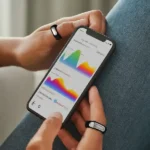
Image Example: Smart ring fertility tracking
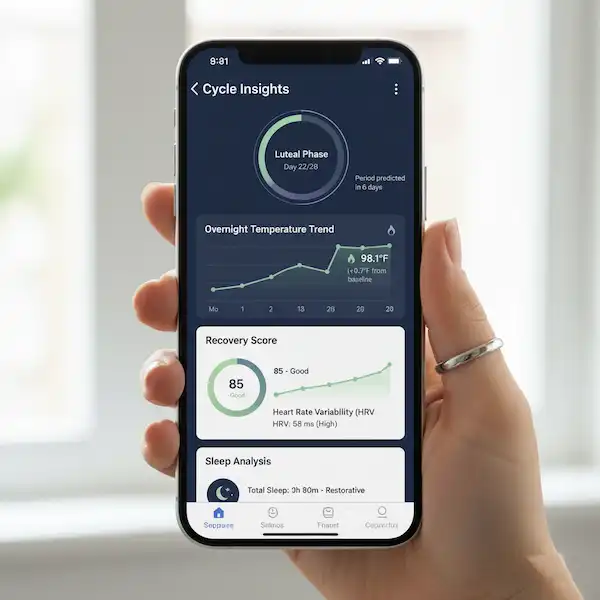
The image shows a mobile app interface displaying “Cycle Insights” from a smart ring. It indicates the current luteal phase, a predicted period, an overnight temperature trend graph with a baseline deviation, a recovery score based on heart rate variability (HRV), and a sleep analysis summary.
Smart Rings and Pregnancy Tracking
For those on a smart ring fertility tracking journey, the moment a positive pregnancy test is confirmed often leads to new questions about how to continue monitoring health. While smart rings are not medical devices for pregnancy, they can offer supportive data.
- Sustained Elevated Temperature: A sustained elevation in BBT beyond the typical luteal phase length can sometimes be an early indicator of pregnancy. Many users first suspect pregnancy when their ring continues to show high temperatures past their expected period.
- Sleep and Recovery during Pregnancy: Pregnancy often brings changes in sleep patterns and increased fatigue. Smart rings can provide objective data on sleep quality, duration, and recovery, helping pregnant individuals understand their body’s needs and communicate with their healthcare providers.
- Heart Rate Variability (HRV) Changes: HRV can shift during pregnancy, reflecting the significant physiological changes occurring. Tracking these trends can offer a general overview of the body’s adaptation.
Important Note: Smart rings are not a substitute for professional prenatal care. Any health concerns during pregnancy should always be discussed with a qualified healthcare provider.
Additional Helpful Content
Tips for Using Your Smart Ring for Fertility Tracking:
- Wear Consistently: For the most accurate data, wear your ring every night, removing it only for charging.
- Sync Daily: Ensure your ring syncs with its app and any integrated fertility apps daily to capture all data.
- Monitor Trends, Not Just Single Readings: Focus on overall temperature shifts and patterns rather than individual daily temperatures.
- Consider Other Symptoms: Combine ring data with other fertility signs like cervical mucus changes for a more complete picture.
- Be Patient: It can take a few cycles for the algorithm to learn your unique rhythm.
Potential Limitations:
- Not a Contraceptive (on its own): While apps like Natural Cycles can be used for contraception, the ring itself is a data collection device.
- External Factors: Illness, alcohol consumption, and significant changes in sleep schedule can temporarily impact temperature readings.
- Cost: Smart rings represent an investment, and some app integrations may require subscriptions.
Frequently Asked Questions (FAQ)
Q: Can a smart ring replace a traditional BBT thermometer? A: For consistent, automated overnight temperature tracking, a smart ring can often be more accurate and convenient than a traditional thermometer. However, always follow your healthcare provider’s advice.
Q: Is the Oura Ring the only smart ring for fertility tracking? A: While the Oura Ring is widely recognized and used for this purpose, other smart rings are emerging with similar capabilities. Always research and compare features.
Q: How soon can a smart ring detect pregnancy? A: A sustained elevation in BBT identified by the ring can be an early indicator, sometimes even before a missed period. However, a positive pregnancy test is the definitive confirmation.
Q: Do I still need to see a doctor if I’m using a smart ring for fertility or health tracking? A: Absolutely. Smart rings are wellness tools and provide data to inform you. They do not replace professional medical advice, diagnosis, or treatment. Regular check-ups with your gynecologist or healthcare provider are essential.
Q: Can medications affect smart ring temperature readings? A: Yes, certain medications, particularly hormonal treatments, can influence your body temperature and thus affect the readings from your smart ring. Always discuss this with your doctor.
Additional Helpful Links
- Read more about Oura ring problems and solutions – Oura Ring Problems and Solutions: Ultimate Troubleshooting
External Links for Authoritative Sources:
- Oura Ring Health Insights: https://ouraring.com/blog/ (A valuable source for scientific validation and articles related to smart ring data.)
- Natural Cycles Scientific Publications: https://www.naturalcycles.com/en-us/natural-cycles-research (Provides access to studies on their app’s effectiveness and FDA clearance.)
- Mayo Clinic – Basal Body Temperature: https://www.mayoclinic.org/tests-procedures/basal-body-temperature/about/pac-20393021 (Reliable medical information on BBT and fertility.)
- American College of Obstetricians and Gynecologists (ACOG): https://www.acog.org/ (A leading professional organization for women’s health.)