Smart Ring Fitness Tracking: Unpacking the Accuracy
Smart rings have emerged as sleek, discreet alternatives to traditional smartwatches for fitness tracking. But how accurate are these tiny tech marvels when it comes to monitoring your health and activity? In this comprehensive guide, we’ll delve into the world of smart ring fitness tracking accuracy, providing examples, insights, and expert advice to help you make informed decisions.
The Allure of the Smart Ring
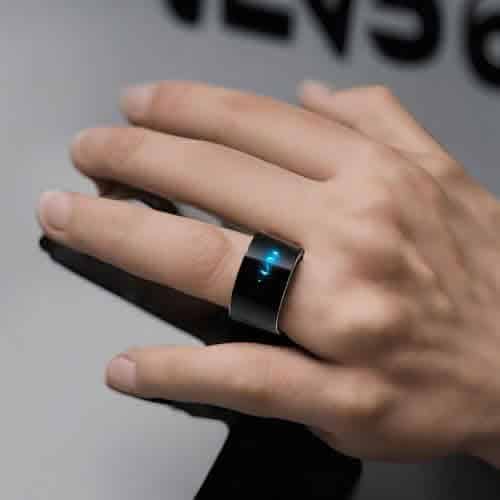
Imagine a fitness tracker that seamlessly integrates into your daily life – no bulky watch on your wrist, no charging woes every night. That’s the promise of the smart ring. These minimalist devices pack a surprising amount of technology, from optical heart rate sensors to accelerometers, all designed to provide insights into your well-being.
Key Metrics: What Smart Rings Track
Before we dive into smart ring fitness tracking accuracy, let’s understand what data smart rings typically collect:
- Heart Rate (HR): Resting heart rate, heart rate variability (HRV), and sometimes real-time active heart rate.
- Sleep Tracking: Sleep stages (light, deep, REM), sleep duration, disturbances, and overall sleep quality.
- Activity Tracking: Steps, calories burned, distance, and activity intensity.
- Temperature: Body temperature variations, often used for illness detection or menstrual cycle tracking.
- Stress & Recovery: Derived from a combination of HR, HRV, and sleep data.
Understanding Accuracy: A Nuanced Perspective
When we talk about accuracy in smart ring fitness tracking accuracy, it’s crucial to understand that “perfect” accuracy is often elusive in real-world conditions. Instead, we look for reliability and consistency in measurements, and how closely they align with clinical-grade equipment.
Heart Rate Tracking Accuracy
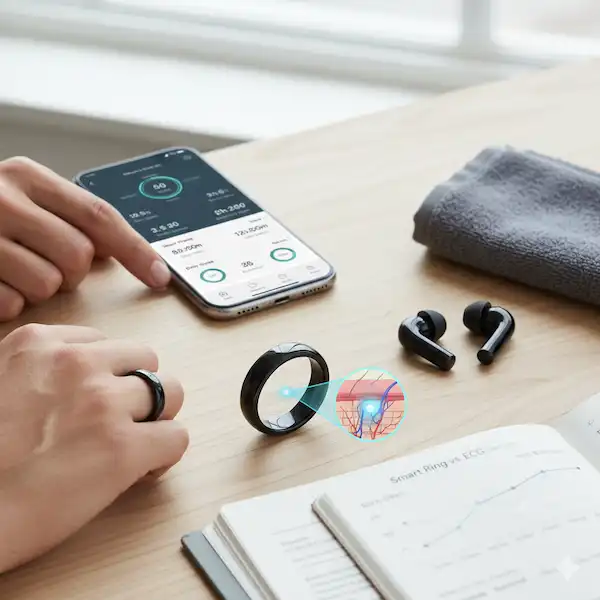
Heart rate monitoring is a cornerstone of fitness tracking. Smart rings typically use photoplethysmography (PPG) sensors, which shine an LED light onto your skin and measure changes in light absorption to detect blood flow.
How it Works: A typical smart ring’s PPG sensor:

Factors Affecting HR Accuracy:
- Fit: A snug fit is paramount. A loose ring can lead to “optical crosstalk” where ambient light interferes with readings.
- Skin Tone & Tattoos: Darker skin tones or tattoos can sometimes absorb more light, making it harder for the sensor to get a clear signal.
- Movement Artifacts: Intense exercise with vigorous arm movements can cause the ring to shift, leading to inaccurate readings.
- Temperature: Extremes in temperature can affect blood flow and sensor performance.
Examples:
- Resting Heart Rate (RHR): Most smart rings excel at measuring RHR. Studies often show a strong correlation (r > 0.90) with ECG measurements for RHR. This is because the user is still, minimizing movement artifacts.
- Heart Rate Variability (HRV): HRV is a key indicator of recovery and stress. Smart rings generally provide reliable HRV data, particularly during sleep when the body is at rest. This data is often comparable to chest strap monitors.
- Active Heart Rate: This is where accuracy can vary more significantly. During a steady-state run, a good smart ring might be within 5-10 bpm of a chest strap. However, during high-intensity interval training (HIIT) with rapid changes in heart rate and movement, the discrepancy can be larger.
Chart: Illustrative HR Accuracy Comparison
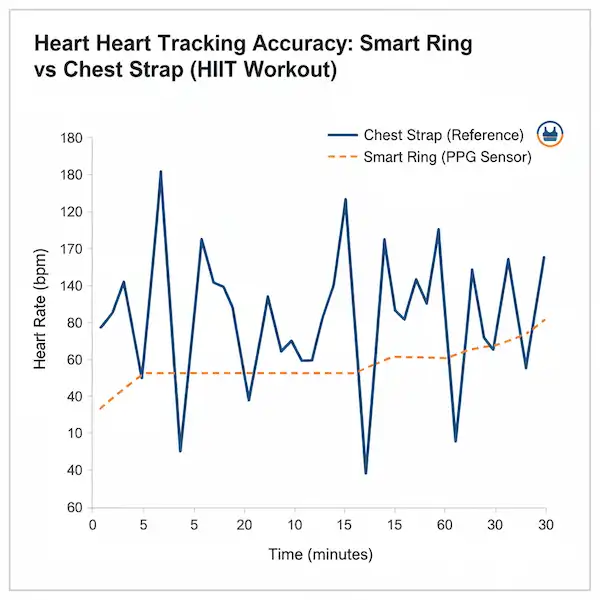
Self-Correction: Note how the smart ring struggles to keep up with rapid HR changes during a HIIT workout, often smoothing out the peaks and troughs.
Sleep Tracking Accuracy
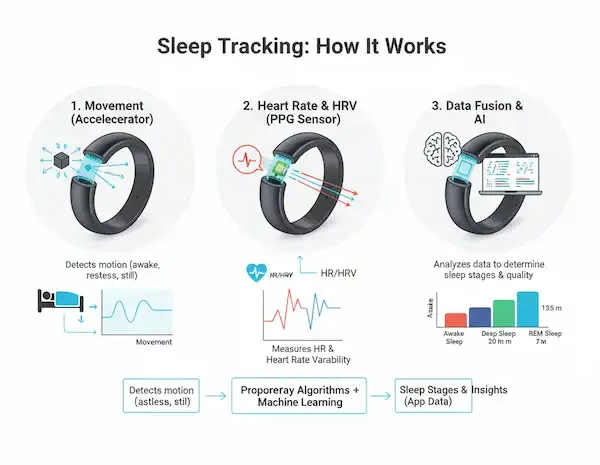
Sleep tracking is a major selling point for smart rings due to their comfortable form factor. They use accelerometers to detect movement and PPG sensors for heart rate data to infer sleep stages.
How it Works:
Factors Affecting Sleep Accuracy:
- Algorithms: The proprietary algorithms used by each brand play a huge role.
- Individual Sleep Patterns: Highly irregular sleep can be harder to interpret.
- External Disturbances: Waking up to use the restroom, restless leg syndrome, or even a pet in the bed can be misinterpreted.
Examples:
- Sleep Onset & Wake Times: Smart rings are generally very accurate in detecting when you fall asleep and when you wake up, often within minutes of self-reported times or polysomnography (PSG – the gold standard for sleep studies).
- Total Sleep Duration: This metric is also highly reliable.
- Sleep Stages (Light, Deep, REM): This is the most challenging aspect. While smart rings can identify these stages, their classification may not always perfectly match PSG. They often do a good job of differentiating between “restful” (deep/REM) and “light” sleep, providing actionable insights. Some studies show agreements ranging from 60-80% for sleep stage classification compared to PSG, which is impressive for a consumer device.
Chart: Illustrative Sleep Stage Accuracy
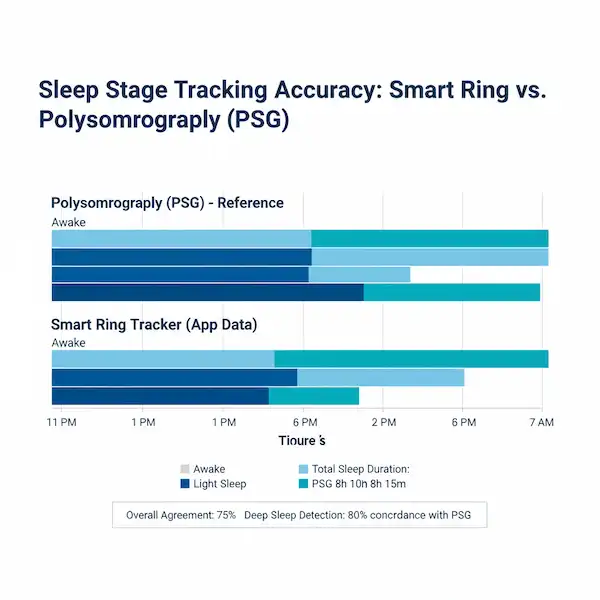
Self-Correction: While the smart ring captures overall sleep duration well, there might be slight discrepancies in the exact timing or duration of specific sleep stages compared to the PSG.
Smart Ring Fitness Activity Tracking Accuracy (Steps, Calories)
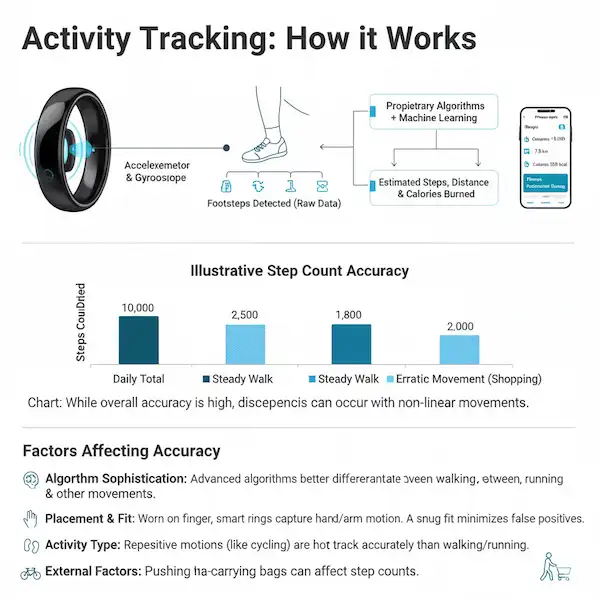
Smart rings use built-in accelerometers and gyroscopes to detect motion, translate it into steps, and estimate calories burned.
How it Works:
Factors Affecting Smart Ring Fitness Tracking Accuracy:
- Placement: Rings are worn on the finger, so they capture arm and hand movements in addition to full-body motion.
- Algorithm Sophistication: Advanced algorithms can better differentiate between walking, running, and other movements.
- Activity Type: Highly repetitive motions (like cycling or pushing a stroller) are often not accurately tracked as steps.
- Erratice Movement: Random hand gestures or fidgeting can sometimes be misinterpreted as steps.
Examples:
- Step Counts: For consistent walking or running, smart rings often provide step counts that are within 5-10% of manual counts or research-grade pedometers. However, for less linear movements (e.g., shopping, gardening), accuracy can decrease.
- Calorie Burn: Calorie estimations are notoriously difficult for any wearable. Smart rings use your basal metabolic rate (BMR) combined with activity data. While they provide a useful trend, treat the exact number as an estimate rather than a precise measurement. They are generally more accurate for estimating activity calories rather than total daily energy expenditure.
The Importance of Personal Baseline
Regardless of the device, establishing a personal baseline is key. Even if a smart ring isn’t 100% accurate compared to a lab test, if it’s consistently tracking your heart rate or your sleep patterns, it can still provide invaluable insights into your personal trends and how your body responds to different inputs (e.g., exercise, stress, diet).
How to Maximize Your Smart Ring Fitness Tracking Accuracy
- Ensure a Snug Fit: The ring should be tight enough not to rotate freely but comfortable enough for all-day wear.
- Wear on the Recommended Finger: Most manufacturers suggest the index, middle, or ring finger. Experiment to find what works best for you.
- Keep it Clean: Regularly wipe the sensors on the inside of the ring.
- Update Firmware: Manufacturers constantly refine their algorithms, so keep your device updated.
- Understand Limitations: Don’t expect medical-grade precision from a consumer device, especially during high-intensity, erratic activities.
Frequently Asked Questions (FAQ) – Smart Ring Fitness Tracking Accuracy
Q: Are smart rings as accurate as smartwatches for fitness tracking? A: For resting metrics like RHR and sleep, smart rings can be very comparable. For active heart rate during intense, dynamic workouts, smartwatches (especially those with larger sensor arrays or closer skin contact) might sometimes have an edge, but the gap is closing.
Q: Can smart rings detect health conditions? A: Smart rings are not medical devices. While they can alert you to abnormal heart rates, significant changes in body temperature, or sleep disturbances, these are indicators for you to consult a healthcare professional, not a diagnosis.
Q: How do smart rings handle water activities? A: Most smart rings are water-resistant and suitable for swimming. However, heart rate tracking during swimming can be less accurate due to water interference with optical sensors.
Q: Is there a “most accurate” smart ring? A: Accuracy varies between brands and models, and often depends on the specific metric. Brands like Oura Ring are frequently cited in research for their sleep and HRV accuracy, but others are constantly improving. Always check recent independent reviews and studies.
Additional Helpful Links
- This is the main article about health tracking data accuracy – Smart Ring Accuracy: How Reliable is Health Tracking Data?
- Learn more about sharing smart ring fitness data – Smart Ring Fitness Data: Sync with Strava & Garmin
Authoritative External Links
- PubMed – Scientific Studies on Wearable Accuracy: https://pubmed.ncbi.nlm.nih.gov/ (Search for specific smart ring brands or “wearable accuracy PPG” to find research papers)
- NIH National Institute of Biomedical Imaging and Bioengineering – Photoplethysmography: https://www.nibib.nih.gov/ (A good resource for understanding PPG technology)
- Sleep Foundation – Understanding Sleep Stages: https://www.sleepfoundation.org/ (For background on the sleep metrics tracked by rings)