Facing Smart Ring Fitness Tracking Limitations
If you have spent any time in a fitness-focused circle lately, you have probably seen someone sporting a sleek, titanium band that looks more like a piece of jewelry than a piece of tech. I was one of those early adopters. There is something undeniably cool about ditching the bulky, glowing screen on your wrist for a minimalist circle on your finger. However, after a year of trying to make this form factor my primary coach for marathon training and heavy lifting, I’ve had to confront some hard truths.
While these devices are marvelous for sleep and general wellness, we need to talk about the smart ring fitness tracking limitations that manufacturers often downplay in their glossy marketing. If you are a serious athlete, a weekend warrior, or someone who spends their mornings under a barbell, you might find that the ring life isn’t as seamless as it looks.
The Anatomy of a Signal: Why Fingers Struggle with HIIT
To understand why rings often miss the mark during a hard workout, we have to look at how they actually “see” your heart. Most wearables use Photoplethysmography (PPG) sensors—those little green or red lights on the back of the device. These lights shine through your skin to measure blood volume changes in your capillaries.+1
On paper, the finger is a goldmine for data. The digital arteries are closer to the surface than the radial artery in your wrist. This is why hospitals use finger clips for pulse oximetry. But here is the catch: hospitals expect you to lie still. In a clinical setting, a finger sensor is the gold standard for accuracy. In a CrossFit box, it’s a different story.+1
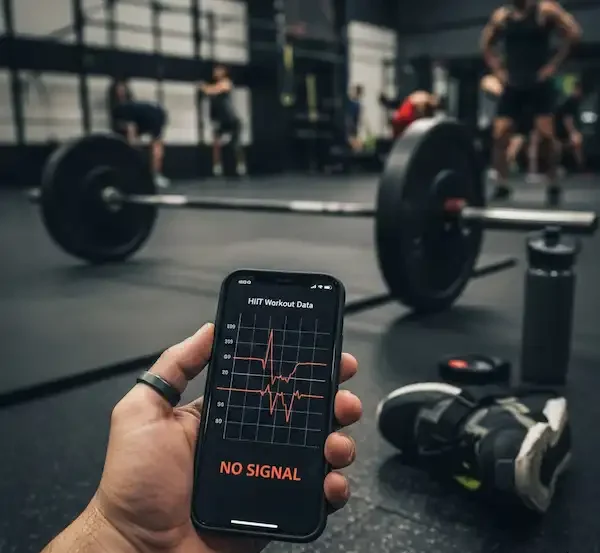
During high-intensity interval training (HIIT), your hands are moving constantly. Whether you’re doing burpees, mountain climbers, or shadowboxing, that motion creates what industry insiders call “motion artifacts.” Because a ring is rigid and sits on a bony digit, any gap created by movement allows ambient light to “leak” into the sensor. This creates noise in the data. From my experience, while my Garmin watch or a chest strap would catch my heart rate spiking to 175 BPM during a sprint, my ring would often lag behind, hovering at 140 BPM because its algorithm was “smoothing out” the noise to avoid a false reading.
The Missing Screen and the Real-Time Data Gap
One of the most significant smart ring fitness tracking limitations is the lack of an interface. This seems obvious—it’s a ring, after all—but the psychological impact on your training is massive.
When I’m out for a run, I need to know my current pace, my lap splits, and my heart rate zone. With a smart ring, that data is locked inside your phone. To see how you’re doing, you have to pull out your smartphone, unlock it, and open an app. In the middle of a 10-mile tempo run, that is not just inconvenient; it’s practically impossible.
Most rings today, including the Oura Ring Gen 4 or the Samsung Galaxy Ring, do not have built-in GPS. They rely on “tethered GPS,” which means the ring “borrows” the location data from your phone. If you want a map of your run or accurate distance tracking, you must carry your phone with you. For those of us who enjoy the “phone-free” liberation of a dedicated sports watch with multi-band GNSS, this feels like a step backward.
The Safety Hazard: Why Weightlifters Should Be Wary
If you are into powerlifting or Olympic lifting, you need to be aware of a specific set of smart ring fitness tracking limitations that go beyond just data accuracy. I learned this the hard way during a set of heavy deadlifts.
When you wrap your hand around a knurled steel bar, the pressure is immense. A smart ring, usually made of titanium or a high-strength polymer, does not “give.” I felt the ring pressing into my finger bone, creating a painful pinch point that actually compromised my grip. Even worse, the friction between the metal bar and the ring’s coating can lead to permanent scuffing on your expensive tech.
But there is a darker side to wearing rings during physical labor or heavy lifting: ring avulsion. This is a traumatic injury where a ring gets caught on an object (like a pull-up bar or a weight plate) and the force of the movement pulls the skin and soft tissue—sometimes the entire digit—off the bone. Organizations like the Cleveland Clinic have documented how common this can be in high-impact environments.
For weightlifting, my advice is simple: Take the ring off. Most rings won’t accurately track your “strain” during a lift anyway because they aren’t designed to measure the isometric tension of your muscles. They primarily look at heart rate, and as we’ve established, they struggle with that during high-intensity movement.
Combat Sports and Contact: A Non-Starter
If your idea of a workout involves Brazilian Jiu-Jitsu (BJJ), boxing, or Muay Thai, you can forget about wearing a smart ring. In these sports, wearing any jewelry is a safety violation. A ring can cut an opponent during a clinch, or it can get snagged in a gi, leading to a broken finger for you.
This creates a massive “data hole” in your daily tracking. If you train in combat sports for two hours a day, your smart ring will see that time as a “gap” in your activity. While you can manually log the exercise later, you lose the granular heart rate and calorie data that makes these trackers useful in the first place. This is a primary example of smart ring fitness tracking limitations—the form factor itself excludes entire categories of athletic endeavor.
Android vs. iPhone: The Ecosystem Friction
Whether you are on Android or iPhone, the way these rings integrate with your existing health data varies wildly. On an iPhone, most rings sync with Apple Health. On Android, it’s a bit more fragmented between Google Fit, Samsung Health, and the newer Health Connect platform.
I’ve noticed that when using an Oura ring with an iPhone, there is often a delay in how the “Active Calories” are credited. If I go for a walk and come back, the ring might take five to ten minutes to sync that data to the phone. In contrast, an Apple Watch provides that feedback instantly. For Android users, the experience is similar; the “syncing” wheel becomes a common sight. While these platforms are getting better, the “live” connection between a ring and a phone is rarely as robust as the connection between a watch and its native OS.
The Industry Insider Perspective: Algorithmic “Smoothing”
Why do rings struggle so much with heart rate during exercise? I once spoke with a hardware engineer who worked on PPG sensors, and he explained the concept of “sampling rates.”
To save battery, smart rings often sample your heart rate less frequently than a dedicated sports watch. While a Garmin might check your pulse every second during a “Work Out” mode, a ring might only check every 5 or 10 seconds to keep its small battery from dying.
When your heart rate is climbing rapidly during a set of hill repeats, a 10-second gap is an eternity. The ring’s software then has to “guess” or interpolate the data between those points. This results in a smoothed-out graph that looks pretty but misses the actual peaks and valleys of your performance. This is one of the “hidden” smart ring fitness tracking limitations that isn’t listed on the box.
Specific Guidance: How to Handle “Ring-Off” Activities
If you’ve decided to buy a ring for its excellent sleep and recovery metrics, but you still want to track your training, here is how I handle the smart ring fitness tracking limitations in my own routine:
- The Hybrid Approach: I wear my ring 24/7 for sleep, HRV (Heart Rate Variability), and recovery scores. However, when I head to the gym or go for a run, I put on my sports watch.
- Manual Syncing: Most high-end apps (like Oura or Ultrahuman) allow you to import data from Apple Health or Health Connect. This means my “Watch” workout gets sent to my “Ring” app, so my daily readiness score stays accurate.
- The “Safety Spot”: If you are lifting, buy a small silicone “wedding band” protector or a “clip” for your gym bag. Don’t just leave your $400 ring on the gym floor or in an unsecured locker.
- Chest Straps are King: If you really want the best heart rate data for HIIT and don’t want to wear a watch, use a Bluetooth chest strap (like a Polar H10). Most smart ring apps can now pull data directly from these straps, bypassing the ring’s optical sensor during the workout.
The Verdict: Who is the Ring For?
Despite the smart ring fitness tracking limitations, I haven’t thrown mine in a drawer. It remains the best tool I’ve ever used for tracking my recovery and detecting if I’m getting sick before I even feel symptoms. But I’ve had to stop thinking of it as a “sports” device.
A smart ring is a “wellness” device. It is for the person who walks 10,000 steps, does yoga, and wants to understand their sleep. It is not for the person trying to shave 30 seconds off their 5K or the person aiming for a 500lb squat.
FAQ: Navigating Smart Ring Fitness Tracking Limitations
Q: Can I wear my smart ring while swimming? A: Most smart rings are water-resistant up to 100 meters (10ATM). However, water can interfere with the PPG sensor’s accuracy. Also, if the water is cold, your finger can shrink, causing the ring to slip off—which is a very expensive way to end a pool session.
Q: Does the ring track steps accurately if I’m pushing a stroller or a grocery cart? A: This is one of the classic smart ring fitness tracking limitations. Because the ring relies on your hand’s movement to “count” steps, if your hand is stationary on a handle, it may miss those steps entirely. Wrist-based trackers often have the same issue, but because rings have smaller accelerometers, the error margin can be higher.
Q: Will a smart ring replace my Garmin or Apple Watch for marathon training? A: In short, no. The lack of real-time pacing, native GPS, and the lower heart rate sampling rate makes a ring a poor choice for competitive distance running. It’s a great companion for the “rest” part of your training, but not the “active” part.
Q: Is it safe to wear a smart ring during kettlebell workouts? A: I strongly advise against it. The impact of a kettlebell against a titanium ring can be painful and may damage the ring’s internal sensors. For any “impact” or “grip” heavy workout, the smart ring fitness tracking limitations regarding physical durability and safety are too high to ignore.
Q: Does skin tone affect smart ring fitness tracking limitations? A: Like all PPG-based devices, people with darker skin tones may experience lower accuracy with green-light sensors. Some rings use infrared or red lights to penetrate deeper, which can help, but it’s an industry-wide challenge that users should be aware of. For more on this, check out research on PPG sensor accuracy across skin tones.
Conclusion: Finding the Balance
If you’re looking to purchase a smart ring, do so with your eyes wide open. Understand that you are buying a world-class recovery monitor that happens to be a mediocre sports tracker. By acknowledging these smart ring fitness tracking limitations, you can build a wearable strategy that actually supports your goals.
For me, that means the ring stays on for the 22 hours a day when I’m living my life, and it comes off for the 2 hours when I’m pushing my limits. It’s not a perfect all-in-one solution, but once you accept that, it becomes a very useful tool in your kit.
Additional Helpful Information
- Study about how to use a smart ring as a fitness tracker – Smart Ring Fitness Tracker: The Essential Guide
- Which smart ring is best for athletics – The Best Smart Ring for Athletes