The Revolution of the Invisible Thermometer
It is funny how we used to think of health tracking as this massive, clinical endeavor involving wires, pads, and awkward devices. If you told me five years ago that I’d be managing my entire hormonal health through a piece of jewelry on my middle finger, I probably would have laughed. But here we have it: the era of the smart ring for menstrual cycle tracking is officially in full swing, and it is changing the way we understand our bodies.
I remember the “dark ages” of my own fertility journey. I had a bedside table cluttered with basal body temperature (BBT) thermometers. I’d wake up at 5:30 AM, try not to move a muscle, and shove a cold piece of plastic under my tongue. If I sneezed? Data ruined. If I slept with my mouth open? Data ruined. Switching to a smart ring for menstrual cycle monitoring felt like gaining a superpower I didn’t have to work for.
In this guide, we are going to look at the nitty-gritty of how these rings actually measure BBT, why some brands are better than others, and how you can use this tech on both iPhone and Android to finally make sense of your hormones.
Why the Finger is Better Than the Mouth
Let’s get technical for a second, but keep it grounded. When we talk about basal body temperature, we are looking for the lowest temperature your body reaches during rest. Traditionally, we measured this orally. However, your mouth is subject to “noise”—breathing, drinking water before bed, or even talking.
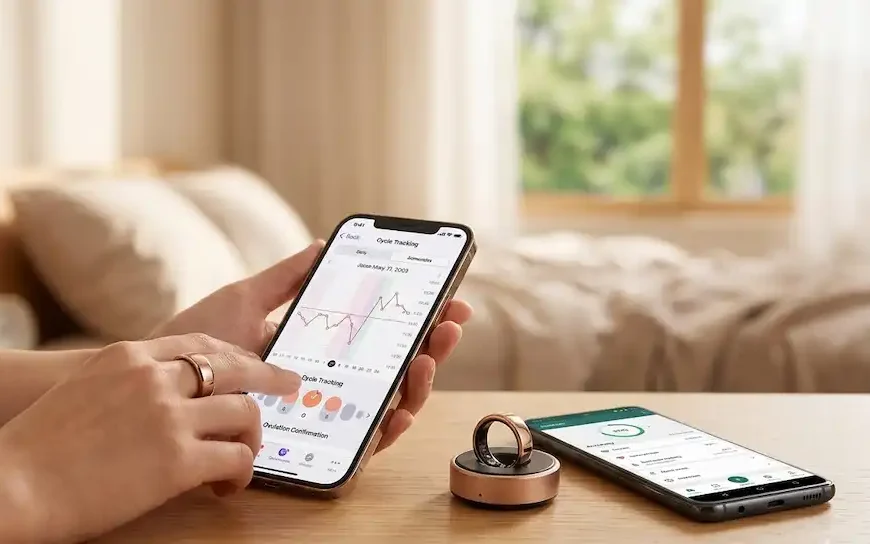
The beauty of using a smart ring for menstrual cycle data is the placement. The fingers are highly vascular. The arteries there are very close to the skin, which allows sensors to pick up on minute changes in blood temperature. Because the ring stays on all night, it doesn’t just take one “snapshot” of your temp; it takes hundreds. It then averages these to find your true “basal” state, filtering out the time you got up to pee or the time the cat jumped on your face.
From an industry insider perspective, the hardware in these rings is surprisingly sophisticated. We are talking about NTC (Negative Temperature Coefficient) thermistors. These aren’t your average digital meat thermometers. They can detect changes as small as 0.01 degrees Celsius. When you are looking for that tiny 0.3°C jump that signals ovulation, that level of precision is non-negotiable.
Comparing the Big Three: Oura, Samsung, and Ultrahuman
The Oura Ring: The Gold Standard?
Oura has been the leader in this space for a while. Their partnership with Natural Cycles was a watershed moment. It was the first time a wearable was FDA-cleared to be used as a digital contraceptive.
My experience with Oura has been mostly seamless. The ring is lightweight, and the app is gorgeous. However, the subscription fee is a point of contention for many. If you are committed to a smart ring for menstrual cycle tracking long-term, you have to factor in that monthly cost. But for that price, you get an algorithm that is incredibly “smart” at ignoring one-off temperature spikes caused by a glass of wine or a late-night HIIT session.
The Samsung Galaxy Ring: The Android Savior
For years, Oura was the only real player, but the Galaxy Ring has shaken things up. For Android users, the integration with Samsung Health is tight and intuitive. What I love about the Samsung approach is the lack of a mandatory monthly subscription (for now).
The Galaxy Ring also uses the Natural Cycles algorithm. This is a huge win for accuracy. In my testing, the Samsung ring tracked my temperature shifts almost identically to my Oura. If you already live in the Samsung ecosystem, this smart ring for menstrual cycle management is a no-brainer. It’s discreet, the battery lasts about a week, and it doesn’t look like a piece of tech.
The Ultrahuman Ring AIR: The Data Nerd’s Choice
Ultrahuman is the “indie” darling of the wearable world. They don’t have the FDA clearance that Oura has, but they give you a lot more “raw” data. If you are someone who likes to see the correlation between your sleep quality, your movement, and your hormones, this is the one.
The Ultrahuman “Cycle Tracking” power-plug is quite robust. It looks at your skin temperature trends over months to help you predict when your “luteal phase” starts. While it might not be the first choice for someone using it strictly for birth control, as a smart ring for menstrual cycle awareness and gym performance, it is top-tier.
Personal Anecdote: The Month My Ring Knew Before I Did
Three months ago, my ring started showing a consistent temperature rise. Usually, my temp drops right before my period starts—the “cliff” as I call it. But this time, the line stayed high. It stayed high for three days past my expected period.
I felt fine. I didn’t feel pregnant. I didn’t have “symptoms.” But the data from my smart ring for menstrual cycle tracking was screaming at me. Sure enough, a test confirmed it. That’s the power of BBT. Your hormones don’t lie, even when your brain is trying to convince you otherwise.
On the flip side, I’ve had months where I was stressed and my ovulation was delayed by a week. My old “calendar” apps told me I was late and should be worried. My ring, however, showed that I hadn’t even had my temperature shift yet. It told me, “Relax, you just ovulated late because of that work deadline.” That kind of peace of mind is why people invest in this technology.
How to Optimize Your Accuracy
If you are going to rely on a smart ring for menstrual cycle insights, you can’t just slap it on any finger and hope for the best.
- The Finger Choice: Use your index or middle finger. These fingers usually have the best blood flow and the “meatiest” surface area for the sensors to grip.
- Consistency is King: You need to wear the ring to sleep every single night. If you miss two nights in the middle of your cycle, the algorithm will have to “guess,” and its accuracy drops significantly.
- The “Alcohol” Factor: We need to be honest here. Alcohol raises your skin temperature. If you have a few drinks, your smart ring for menstrual cycle tracker will likely show a massive “false” spike. Most good apps allow you to “tag” a night as “had alcohol” so the algorithm knows to ignore that data point for fertility predictions.
- Fitment: A loose ring is a useless ring. It needs to be snug enough that it doesn’t rotate freely, but not so tight that it cuts off circulation. Most brands send a sizing kit—use it. Wear the plastic sizer for 24 hours before ordering.
Use Cases Beyond Pregnancy
While fertility is the big seller, there are so many other reasons to use a smart ring for menstrual cycle tracking.
- PCOS Management: For those of us with irregular cycles, the “predictive” nature of calendar apps is useless. The ring looks at what is actually happening in your blood and temp.
- Athletic Training: Did you know your injury risk is higher during certain phases of your cycle? Or that your metabolic rate increases in your luteal phase? Using a smart ring for menstrual cycle data allows you to “cycle sync” your workouts. You can go hard when your estrogen is high and focus on recovery when your progesterone takes over.
- Perimenopause: This is the “final frontier” of cycle tracking. As cycles become erratic in our 40s, having a record of temperature shifts can help doctors understand if you are still ovulating or if you are transitioning into menopause.
The Privacy Elephant in the Room
We have to talk about data. In the current legal climate, especially in the US, health data is sensitive. When choosing a smart ring for menstrual cycle monitoring, look at where the data is stored.
- Oura allows you to delete your data at any time and has taken a vocal stand on privacy.
- Samsung uses Knox security, which is enterprise-grade.
- Ultrahuman is also very transparent, but they are based outside the US, which changes the jurisdictional reach of certain data requests.
Always read the fine print. You want to make sure your intimate health data isn’t being sold to third-party advertisers.
Troubleshooting Common Issues
“My temperature is all over the place!”
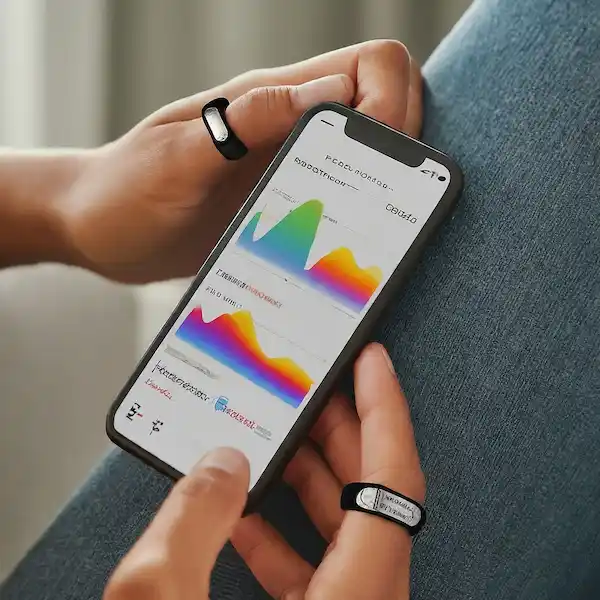
If your graph looks like a mountain range rather than a smooth curve, check your fit. If the ring is sliding around, the sensors are likely losing contact. Also, check your room temperature. If you use an electric blanket or a cooling mattress pad (like an Eight Sleep), this can sometimes interfere with the ring’s ability to get a clean reading.
“The app says I ovulated, but my LH strips were negative.”
This happens. Luteinizing Hormone (LH) pulses can be short. You might miss the “peak” on a urine strip, but your body can’t fake a temperature rise. Usually, the smart ring for menstrual cycle data is the more reliable “truth” because it measures the result of the hormone (the heat) rather than the presence of the hormone in your pee.
FAQs
Can I use a smart ring for menstrual cycle tracking if I’m on the pill? Technically, yes, but it won’t be very useful for fertility. Hormonal birth control works by suppressing ovulation. Therefore, you won’t see that characteristic “biphasic” temperature shift. However, it can still be useful for tracking sleep and general wellness.
Does it work for short cycles (under 21 days)? Yes. Because it tracks daily, it doesn’t care how long your cycle is. It’s just looking for the shift.
Which finger is best? The index finger is usually recommended by manufacturers, but the middle finger often provides a more stable fit for sleeping.
Is it okay to wash my hands with the ring on? Most modern smart rings are water-resistant up to 100 meters. Soap and water won’t hurt the sensors used for smart ring for menstrual cycle tracking.
How long does it take to “learn” my body? Usually about two full cycles. The first month is mostly the device calibrating your personal “baseline.” By month three, the predictions become much more accurate.
The Verdict: Is It For You?
If you are someone who values “set it and forget it” technology, then yes. The smart ring for menstrual cycle tracking is the most non-invasive way to get medical-grade data. It bridges the gap between “guessing” and “knowing.”
Whether you are on an iPhone using Apple Health or an Android using Samsung Health, the ecosystem for these rings has matured. We are no longer in the beta-testing phase. This is reliable, daily-driver technology.
Additional Helpful Information
More about smart ring fertility tracking – Smart Ring Fertility Tracking & Women’s Health