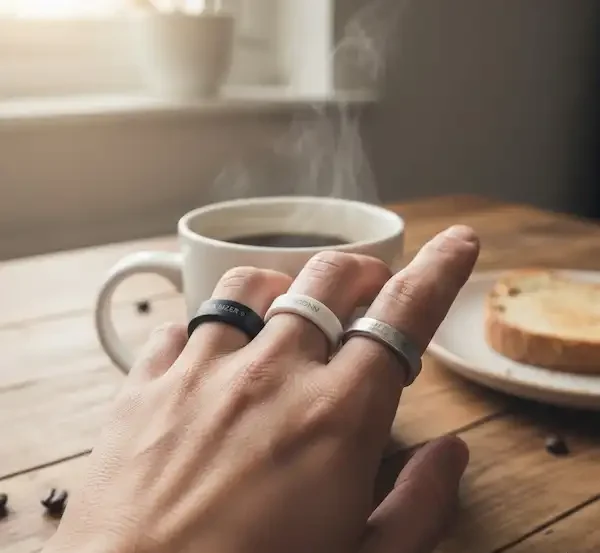
Smart Ring Sizing – Why Millimeters Matter
Buying a smart ring is a lot like buying a high-end pair of running shoes: if the fit is off by even a fraction, you’re going to have a bad time. But with a smart ring, the stakes are a little higher than just a blister. If it’s too loose, your sleep data will look like a work of fiction. If it’s too tight, you’ll be waking up at 3:00 AM with a throbbing finger, desperately searching for the dish soap to slide it off. Continue reading to get the best Smart Ring Sizing so you get accurate data.
I’ve spent the last few years testing everything from the Oura Ring to the newer RingConn and Galaxy rings. Through a lot of trial and error (and one panicked morning involving an ice bath for my hand), I’ve learned that “Smart Ring Sizing” a smart ring is a 24-hour science project, not a five-minute decision.
Why “Close Enough” Doesn’t Work
Standard jewelry rings are designed to look pretty and stay on. Smart rings, however, are essentially miniature medical-grade laboratories wrapped around your finger. They use Photoplethysmography (PPG) sensors—those little green or red lights—to “see” the blood flow in your capillaries.
According to research published in the Journal of Clinical Medicine, PPG sensors require consistent, stable contact with the skin to maintain a high signal-to-noise ratio. If there’s a gap between the sensor and your skin, light “leaks” out, and the ring might miss your heart rate variability (HRV) or blood oxygen (SpO2) levels. Reasons why Smart Ring Sizing is so important.
The Thickness Factor: It’s Not a Wedding Band
One of the biggest shocks for first-time buyers is the thickness. Because these rings house batteries and circuit boards, they are significantly “chunkier” than a traditional gold band. This thickness affects how the ring feels against your neighboring fingers and effects Smart Ring Sizing.
| Smart Ring Model | Approximate Thickness | “Feel” Factor |
| Oura Ring 4 | ~2.88 mm | Flat interior; very “ring-like” |
| Samsung Galaxy Ring | ~2.60 mm | Concave design; feels thinner than it is |
| Ultrahuman Ring Air | ~2.45 – 2.8 mm | Extremely light; classic “tech” feel |
| RingConn Gen 2 | ~2.00 mm | Currently one of the thinnest on the market |
| Traditional Wedding Band | ~1.5 – 2.0 mm | Noticeably slimmer and less intrusive |
The “Living With It” Test: My 24-Hour Rule
When you receive your Smart Ring Sizing kit (and please, always use the manufacturer’s specific kit), don’t just pick the one that feels “okay” and go.
Your fingers are dynamic. They are not the same size at 10:00 AM as they are at 10:00 PM. I learned this the hard way when I sized my first ring in a cold, air-conditioned office. It fit perfectly—until I went for a walk in the humid July heat and my finger turned into a literal sausage.
1. The Morning Swell
Most people wake up with slightly swollen hands. If your ring is already “snug” when you go to bed, it might be painful by sunrise.
- Pro Tip: If you can’t rotate the plastic sizer 360 degrees on your finger when you first wake up, it’s too small.
2. The Activity Expand
When you exercise or even just walk briskly, your blood flow increases and your fingers expand.
- The Experience: I often find that my ring fits my index finger during the day but needs to be moved to my middle finger during a workout to prevent that “pulsing” feeling of restricted circulation.
3. The Salt and Alcohol Effect
Had a salty ramen dinner or a couple of glasses of wine? Your fingers will retain water. This is the ultimate “stress test” for your ring size. If the ring is still comfortable after a night of high-sodium food, you’ve found the sweet spot.
Which Finger is Best?
Most manufacturers, including Oura, recommend the index finger for the best data accuracy. This is because the arteries in your index finger are typically more accessible for the sensors.
However, I’ve found that the middle finger is often the most practical choice. It offers a balance of great data and more “real estate” on either side to accommodate the ring’s thickness. Avoid the pinky if you can; the blood flow is lower, and the data can be noticeably “noisier” or less consistent.
Troubleshooting the “In-Between” Size
Smart Ring Sizing doesn’t come in half-sizes. If you are between a 9 and a 10, here is my personal philosophy: Size up for comfort, size down for data.
If you are a hardcore data nerd who wants every single HRV data point during sleep, the tighter fit (within reason) is better. If you want a device you can forget you’re wearing, go with the larger size. Just keep in mind that a ring that “spins” freely will almost certainly fail to track your sleep stages accurately.
FAQ:
Q: Can I just use my standard jeweler’s ring size?
A: No. Smart rings are thicker and have internal sensor bumps (though the Oura 4 has flattened these out significantly). Always use the specific sizing kit for the brand you are buying.
Q: Should the ring be hard to get over my knuckle?
A: There should be a little resistance. If it slides over your knuckle with zero effort, it’s likely too loose and will shift during the night. If you have to use soap to get it off, it’s definitely too tight.
Q: Does it matter which hand I wear it on?
A: Generally, your non-dominant hand is better. Your dominant hand tends to be slightly larger and moves more, which can lead to “false” activity data (like the ring thinking you’re walking when you’re just chopping vegetables).
Q: What happens if I lose weight or my size changes?
A: This is the downside of smart rings. They aren’t adjustable. However, many users simply move the ring to a different finger (e.g., from index to middle or ring finger) to accommodate changes.
Additional Helpful Links
- A review of the most popular rings – Oura Ring vs Samsung Galaxy Ring vs Ultrahuman Ring Air: 2025 Review