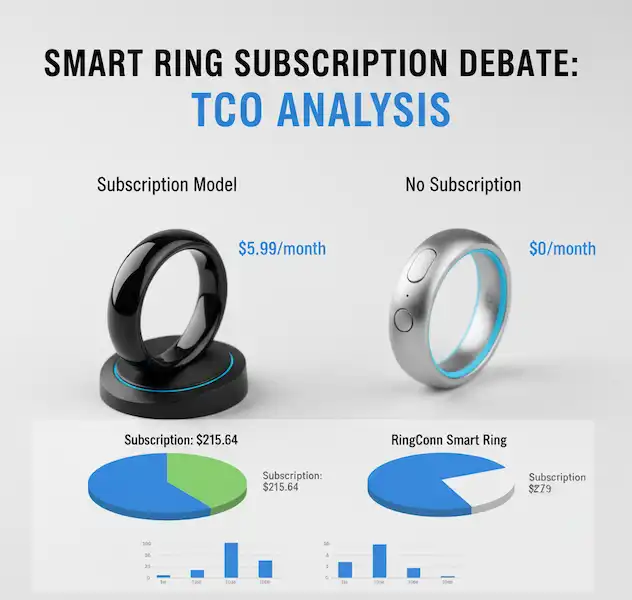
Smart Ring Subscription Model Debate: A Comprehensive TCO Analysis
The smart ring market is booming, offering a discreet way to track fitness, sleep, and overall well-being. But beneath the sleek designs and impressive tech lies a crucial financial consideration: the subscription model. Some popular rings, like Oura and the upcoming Samsung Galaxy Ring, require a mandatory monthly fee to unlock their full potential, while others, such as Ultrahuman and RingConn, offer a smart ring subscription-free experience.
This article provides a comprehensive analysis of the Total Cost of Ownership (TCO) for both models, helping you make an informed decision about your next smart ring purchase. We’ll explore examples, present charts, address frequently asked questions, and provide authoritative external links.
Understanding Total Cost of Ownership (TCO)
TCO isn’t just the initial purchase price; it’s the sum of all costs associated with owning and operating a device over its expected lifespan. For smart rings, this includes:
- Initial Purchase Price: The upfront cost of the ring itself.
- Subscription Fees: Monthly or annual fees required to access all features.
- Accessory Costs: Chargers, cases, or other add-ons (though less common for rings).
- Replacement Costs: The cost of replacing the ring if it’s lost, damaged, or upgraded.
The Subscription Model: Oura Ring and Samsung Galaxy Ring
Companies adopting the smart ring subscription model argue that it allows them to continuously develop new features, maintain cloud infrastructure for data storage and analysis, and provide ongoing support.
Oura Ring: A Pioneer in the Subscription Space
Oura, a well-established player, introduced a mandatory monthly smart ring subscription for new users.
Example: Oura Ring Gen3 Horizon
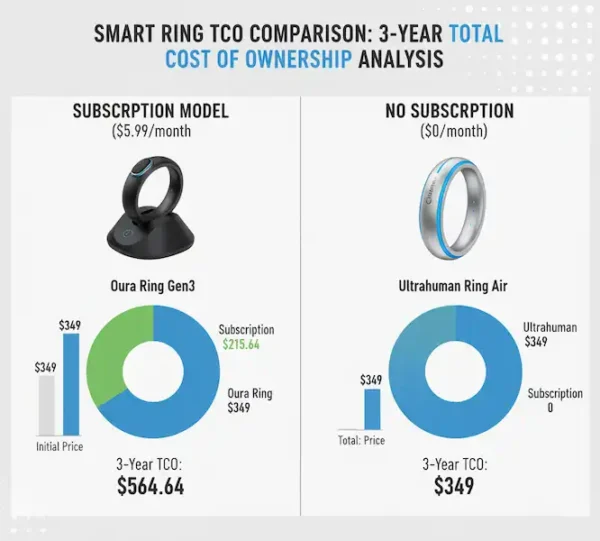
Let’s consider a user owning an Oura Ring for three years.
- Initial Purchase Price: $349
- Monthly Subscription: $5.99
- Annual Subscription: $71.88
- Total Subscription Cost (3 years): $71.88 x 3 = $215.64
- Total Cost of Ownership (3 years): $349 (ring) + $215.64 (subscription) = $564.64
Advantages of Oura’s smart ring subscription:**
- Continuous Innovation: Regular software updates and new feature rollouts.
- Detailed Insights: Advanced health metrics, personalized recommendations, and trend analysis.
- Cloud Data Storage: Secure storage and accessibility of your health data across devices.
Samsung Galaxy Ring: The New Contender
While details are still emerging, industry speculation suggests the Samsung Galaxy Ring will likely follow a similar smart ring subscription model, especially given Samsung’s existing ecosystem services.
Example: Samsung Galaxy Ring (Estimated)
Assuming an initial price similar to Oura and a comparable subscription fee.
- Initial Purchase Price: $300 (estimated)
- Monthly Subscription: $5.99 (estimated)
- Annual Subscription: $71.88
- Total Subscription Cost (3 years): $71.88 x 3 = $215.64
- Total Cost of Ownership (3 years): $300 (ring) + $215.64 (subscription) = $515.64 (estimated)
Potential Advantages of Samsung’s Subscription:
- Ecosystem Integration: Seamless integration with Samsung Health and other Galaxy devices.
- Advanced Features: Leveraging Samsung’s R&D for cutting-edge health tracking.
- Brand Trust: The backing of a global technology giant.
Smart Ring Subscription-Free Competitors: Ultrahuman and RingConn
Subscription-free rings offer a simpler value proposition: pay once, own forever. These companies aim to attract users who prefer not to commit to recurring costs.
Ultrahuman Ring Air: Focus on Bio-markers
Ultrahuman has positioned itself as a smart ring subscription-free alternative, offering a robust set of features with a one-time purchase.
Example: Ultrahuman Ring Air
- Initial Purchase Price: $349
- Monthly Subscription: $0
- Total Subscription Cost (3 years): $0
- Total Cost of Ownership (3 years): $349 (ring) + $0 (subscription) = $349
Advantages of Ultrahuman Ring Air:**
- No Recurring Costs: Predictable expenditure after the initial purchase.
- Comprehensive Metrics: Tracks sleep, activity, heart rate, temperature, and more without hidden fees.
- Developer-Friendly: Potential for third-party integrations (check specific features).
RingConn Smart Ring: Affordability and Functionality
RingConn offers an even more budget-friendly entry point without sacrificing essential tracking capabilities.
Example: RingConn Smart Ring
- Initial Purchase Price: $279
- Monthly Subscription: $0
- Total Subscription Cost (3 years): $0
- Total Cost of Ownership (3 years): $279 (ring) + $0 (subscription) = $279
Advantages of RingConn Smart Ring:
- Lower Entry Cost: More accessible for budget-conscious consumers.
- Essential Tracking: Covers core metrics like sleep, activity, and heart rate.
- Subscription-Free: No ongoing financial commitment.
Comparative TCO Chart (3-Year Ownership)
This chart clearly illustrates the financial impact of subscription fees over a three-year period.
| Smart Ring | Initial Price | Monthly Subscription | 3-Year Subscription Cost | 3-Year Total Cost of Ownership |
| Oura Ring Gen3 | $349 | $5.99 | $215.64 | $564.64 |
| Samsung Galaxy Ring | $300 (est.) | $5.99 (est.) | $215.64 | $515.64 (est.) |
| Ultrahuman Ring Air | $349 | $0 | $0 | $349 |
| RingConn Smart Ring | $279 | $0 | $0 | $279 |
Choosing Your Smart Ring: Beyond the Price Tag**
While TCO is a significant factor, it’s not the only consideration. Here are other crucial elements to weigh:
- Features and Accuracy: Do the features offered align with your needs? How accurate are the sensors?
- App Experience: Is the companion app user-friendly, intuitive, and rich in insights?
- Comfort and Design: Since you’ll wear it constantly, comfort and aesthetic appeal are vital.
- Battery Life: How long does the ring last on a single charge, and how convenient is charging?
- Durability and Water Resistance: Can it withstand your daily activities and potential exposure to water?
- Data Privacy: How does the company handle your sensitive health data?
FAQ: Smart Ring Subscriptions
Q: Why do some smart rings require a subscription?
A: Companies typically use subscription fees to fund ongoing research and development, maintain cloud infrastructure for data analysis and storage, provide continuous software updates, and offer customer support.
Q: Do subscription-free rings offer fewer features?
A: Not necessarily. While subscription models often boast more advanced or personalized insights, many subscription-free rings like Ultrahuman and RingConn provide a comprehensive set of core tracking features (sleep, activity, heart rate, temperature) that are sufficient for most users.
Q: Can I use a subscription-based ring without paying the monthly fee?
A: Usually, no. Most subscription-based rings will have limited or no functionality without an active subscription. You might only be able to see basic metrics or the ring may not even connect to the app.
Q: Is a smart ring subscription tax-deductible?
A: In most cases, no. Smart rings are generally considered personal fitness devices. Consult with a tax professional for specific advice.
Q: How often do smart rings need to be replaced?
A: The lifespan varies, but most smart rings are designed to last 2-3 years or more. Battery degradation and new technology advancements often drive replacement cycles.
Additional Helpful Links
- Discover the 5 top issues with smart rings – Top 5 Smart Ring Issues and How to Solve Them
External Links for Authoritative Sources
- Oura Ring Official Website: https://ouraring.com/
- Ultrahuman Ring Official Website: https://ultrahuman.com/
- RingConn Official Website: https://ringconn.com/