The “Screen” Fatigue: Why I Switched (and Why I Went Back)
A few years ago, I was a total notification junkie. My smartwatch was an extension of my nervous system. Every time a newsletter hit my inbox or someone “liked” a photo, my wrist would buzz. I thought I was being productive. In reality, I was just fragmented.
I remember a specific moment during a movie with my family. My watch screen lit up the dark theater because I moved my arm to grab some popcorn. It was distracting to everyone around me and, honestly, to me too. That was the day I ordered my first smart ring.
The smart ring offered a “silent” alternative. No screen, no vibrations (usually), and no glowing lights during a movie. But—and this is a big “but”—I quickly realized that I missed being able to see my pace while I was out for a run. This is the fundamental trade-off of the smart ring vs smartwatch world: Discretion vs. Data Visibility.
Form Factor: The Physicality of Wearables
The Weight of Innovation
When you look at a smart ring vs smartwatch, the weight difference is staggering. A typical smartwatch, like the Apple Watch Ultra or a Garmin Fenix, can weigh between 60 and 95 grams with a strap. That doesn’t sound like much until you’re trying to sleep. I’ve actually woken up with a “watch-shaped” indent on my forehead because I sleep with my hand under my pillow.
A smart ring, like the Ultrahuman Ring AIR, weighs about 2.4 to 4 grams. It is essentially air. For someone who values “zero-friction” living, the ring wins the form factor battle every time.
The “Clink” Factor (Insider Tip)
Here’s something the marketing teams at Samsung or Oura won’t tell you: Smart rings are loud. Not electronically loud, but physically loud. If you’re a weightlifter, wearing a titanium ring while doing deadlifts or pull-ups is a recipe for a scratched ring and a pinched finger.
I’ve actually had to develop a habit of moving my ring to my “non-dominant” hand during gym sessions. Smartwatches have their own gym issues (they get in the way of wrist wraps), but they don’t risk “degloving” your finger if you catch them on a piece of equipment. If you’re a heavy lifter, this is a serious point for the smartwatch side of the smart ring vs smartwatch debate.
Health Tracking: Where the Magic Happens
The Finger vs. The Wrist
Industry insiders will tell you that the finger is actually a much better place to track heart rate than the wrist. Why? Because the skin on your finger is thinner, and the blood vessels are closer to the surface.
When you wear a smartwatch, the sensor has to shine through more tissue, muscle, and sometimes hair. If the watch isn’t strapped on tight enough to cut off circulation, it can “leak” light, which messes up the readings. This is why your watch might tell you your heart rate is 160 bpm when you’re actually just walking—it’s “cadence locking” onto your footsteps.
Smart rings sit snugly around the base of your finger. They don’t move. For Heart Rate Variability (HRV) and Resting Heart Rate (RHR), the ring is consistently more accurate in my side-by-side testing.
The GPS Gap
If you are a runner, cyclist, or hiker, the ring falls short. There is no such thing as a smart ring with built-in GPS (at least not one that lasts more than an hour). This means you must carry your phone with you if you want to map your route.
The smartwatch is a standalone tool. I can leave my phone at home, head out for a 10-mile trail run, listen to music via Bluetooth, and track my exact elevation and path all from my wrist. If you value that “unplugged” freedom during exercise, the smart ring vs smartwatch choice becomes very clear: stick with the watch.
The Ecosystem War: Android vs. iPhone
The iPhone Experience
If you’re on an iPhone, you’re in a bit of a “walled garden.” The Apple Watch is so deeply integrated that any other wearable feels like a second-class citizen. You can’t reply to iMessages from a ring. You can’t use Apple Pay from a ring (yet).
However, the Oura Ring has done a masterful job of integrating with Apple Health. My “Readiness Score” from Oura shows up as a widget on my iPhone home screen, and it feels native. But you have to be okay with the fact that the ring is a data collector, not an interaction tool.
The Android Revolution
The Android world is currently the most exciting place for the smart ring vs smartwatch rivalry. The Samsung Galaxy Ring changed the game recently.
Samsung did something brilliant: they made the ring and the watch talk to each other. If you wear both, the Samsung Health app knows. It will take the heart rate data from the watch (because it’s more active during the day) and the sleep data from the ring (because it’s more comfortable). It even turns off the ring’s sensors when the watch is active to save battery life. This kind of synergy is what makes the Android ecosystem feel ahead of the curve right now.
Battery Life: The Weekly Ritual vs. The Daily Chore
This is the “make or break” for most users.
- Smartwatches: Even the best “mainstream” watches (Apple/Google) struggle to get past two days. If you use GPS, you’re charging it every night. I have a “charging graveyard” on my nightstand specifically for my watch.
- Smart Rings: I charge my ring while I’m in the shower on Sunday nights. That’s it. Most rings last 5 to 7 days.
The psychological relief of not having to worry about another battery percentage is huge. When you’re traveling, you don’t need a proprietary puck-shaped charger for your ring; you just bring the tiny case.
Insider Knowledge: Watch out for “Battery Degrade.” Because smartwatches have screens and more processors, their batteries tend to degrade faster than the simpler batteries in rings. A two-year-old smartwatch might only give you 60% of its original life, whereas a ring stays fairly consistent.
The Hidden Costs: Subscriptions and Sizing
When comparing smart ring vs smartwatch costs, don’t just look at the MSRP.
The Subscription Trap
Oura famously requires a monthly subscription to see your detailed trends. If you stop paying, you get a “basic” score and not much else. It feels a bit like renting your own health data.
Smartwatches usually don’t do this. Fitbit (Google) has a “Premium” tier, but the core health data is free. Garmin is famously “no subscription ever.” If you hate monthly fees, look at the RingConn or Ultrahuman rings—they are currently subscription-free.
The Sizing Headache
You can’t just buy a ring and wear it. You have to wait for a sizing kit. You wear a plastic ring for 24 hours (please, wear it for 24 hours!). Your fingers swell when you drink alcohol, when you travel on planes, and when you wake up.
I once sized my ring in a cold room in the morning. When I went for a walk in the humid afternoon, my finger turned purple. The smart ring vs smartwatch choice includes a “commitment” to a specific finger. You can’t easily swap a ring from your thumb to your ring finger if it’s too tight. A watch band? You just move it one notch.
Deep Dive: Comparing Specific Subjects
Sleep Tracking
If you care about sleep, the ring wins. Period. Smartwatches are bulky, they catch on sheets, and their green/red lights can leak out and wake up your partner. Rings are invisible at night. The data I get from my ring regarding “Time to Fall Asleep” (Latency) is far more accurate than my watch, which often thinks I’m asleep just because I’m lying still reading a book.
Style and Aesthetics
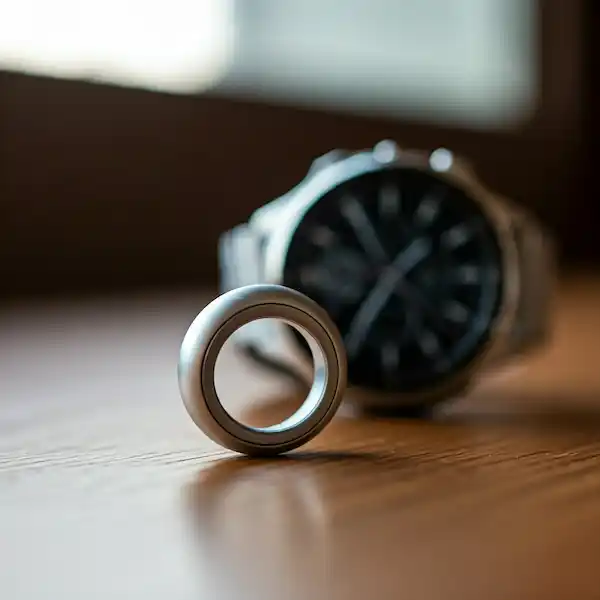
Let’s be honest: smartwatches look like tech. Even the “Hermès” Apple Watch is still a glowing rectangle. A smart ring looks like a wedding band or a piece of statement jewelry.
I’ve worn a smart ring to black-tie weddings, and nobody noticed it was a computer. I’ve worn a Garmin to a wedding, and I looked like I was ready to timing my sprint to the buffet. If you have a collection of nice mechanical watches, a smart ring allows you to keep your “analog” style while still getting the “digital” data.
Durability
Smartwatches have glass. Glass breaks. I’ve cracked two screens by hitting my wrist against a doorframe while carrying groceries.
Smart rings are usually made of Titanium or Ceramic. They are incredibly hard to “break,” though they are very easy to scratch. My black Oura ring now has “patina” (silver scratches) all along the bottom from holding coffee mugs and steering wheels.
Table: Smart Ring vs Smartwatch at a Glance
| Feature | Smart Ring | Smartwatch |
| Primary Use | Passive Health & Sleep | Active Fitness & Productivity |
| Battery Life | 5–7 Days | 1–3 Days (Typical) |
| Notifications | None to Minimal (Vibration) | Full Text/Calls/Apps |
| Accuracy | High (HRV, Sleep) | High (GPS, ECG) |
| Comfort | Exceptional | Moderate to Low (at night) |
| Cost | $250 – $500 | $200 – $800+ |
| Phone Link | Essential for data viewing | Can often function standalone |
The “Silent” Factor: Mental Health and Wearables
One aspect of the smart ring vs smartwatch debate that doesn’t get enough attention is the impact on your mental health.
We live in a world of “constant pings.” A smartwatch is another gatekeeper of your attention. Even if you turn off most notifications, the temptation to “just check the weather” or “see my steps” is always there.
The smart ring is the “stoic” wearable. It gathers data silently. It doesn’t judge you in real-time. It doesn’t buzz when you’re in the middle of a deep conversation. For me, moving to a ring for my daily “driver” reduced my screen time significantly. That’s a lot of life to get back over a year.
I’ve also noticed that “step counting” feels less like a chore with a ring. On a watch, you’re constantly glancing down to see if you hit 10,000. With a ring, you check the app at the end of the day. It shifts the focus from “doing” to “being.”
Accuracy: A Deep Dive into the Sensors
Let’s talk about the photoplethysmography (PPG) sensors. Both devices use light to measure blood flow. On a smartwatch, these sensors are located on the back of the case. Because the wrist has a lot of “noise”—tendons moving, hair, and a thicker layer of fat—the watch often has to use complex algorithms to “guess” your heart rate during heavy movement.
The smart ring’s sensors are located on the inside of the band, pressing directly against the digital arteries in your finger. In the world of clinical research, finger-based PPG is often considered the gold standard for non-invasive monitoring. If you’re looking for the highest possible fidelity for your resting heart rate or oxygen saturation (SpO2), the smart ring vs smartwatch technical edge goes to the finger.
Real World Scenario: The Traveler
I recently took a week-long trip to Japan. I decided to bring both.
- The Smartwatch: Was invaluable for navigation. Having Google Maps on my wrist while navigating the Tokyo subway meant I wasn’t staring at my phone and looking like a target for pickpockets.
- The Smart Ring: Was the only thing I wore on the 14-hour flight. Wearing a heavy watch on a long-haul flight is uncomfortable, and the ring accurately tracked my (admittedly terrible) airplane sleep and my body’s recovery from jet lag.
If you travel often, the smart ring vs smartwatch decision might actually be “both.” But if you can only pick one, think about whether you need a map on your arm or a battery that lasts the whole flight.
Which One Is For You?
If you are the kind of person who wants to “optimize” every second of your workout, who needs to stay connected to your Slack DMs while hiking, and who doesn’t mind a nightly charging ritual, the smartwatch is your tool. It is a powerful, capable wrist-computer.
But, if you are like me—someone who is tired of screens, who wants to track their health without it becoming a hobby, and who values a good night’s sleep above all else—the smart ring is a revelation.
In the smart ring vs smartwatch battle, there is no loser. There is only the choice between being “connected” and being “aware.”
Personally? I wear my ring 24/7 and I keep my watch in my gym bag. I get the best of both worlds: the peace of mind of the ring and the high-octane data of the watch when I actually need it.
FAQ: Everything You’ve Been Wondering
Q: Can I use a smart ring without a smartphone?
A: Not really. While the ring stores data for a few days, you need the app to sync and actually see what’s going on. A smartwatch can at least show you the time and your current heart rate without a phone nearby.
Q: Which finger is best for a smart ring?
A: Industry pros recommend the index finger for the most accurate readings, followed by the middle and ring fingers. Avoid the pinky; the bone structure isn’t ideal for the sensors.
Q: Is “smart ring vs smartwatch” data actually medical grade?
A: No. While some watches have FDA-cleared ECGs (like Apple and Samsung), these are “wellness” devices. They are great for spotting trends, but if you think you have a heart condition, see a doctor. Don’t rely on a $300 ring to save your life.
Q: Will the battery die forever after 2 years?
A: This is a real concern. Because the batteries are so small, they have a finite number of charge cycles. Most rings will start to see a drop in performance after 24–36 months. Unlike a watch, you can’t really “replace” the battery in a ring; it’s usually a full device replacement.
Q: Can I pay for coffee with my ring?
A: Only a few support this. The McLEAR Ring does, but most “health” rings like Oura or Samsung do not currently support NFC payments in all regions. Smartwatches are still the kings of “tap-to-pay.”
Q: Do smart rings work with gloves?
A: Yes, but it depends on the glove. If the glove is very tight, it might press the ring into your finger uncomfortably. However, unlike a smartwatch, you can easily hide a ring under winter gear without losing any data.
Additional helpful information:
- Which is the best for monitoring your heart rate? – Smart Ring or Smartwatch – Which is Best Heart Rate Monitor
- How to resolve the data conflict between wearable devices – Solving the Data Conflict Between Smart Rings and Watches
- Be sure you setup your smart ring correctly – How to setup your Smart Ring – Getting Started
- How accurate is the data from smart rings – Smart Ring Accuracy: How Reliable is Health Tracking Data?
- More information about comparing smart rings to smartwatches – Compare Smart Rings and Smartwatches: Which is Right for You?
Authoritative References for Further Reading: