
The Future of Smart Rings: Why Your Next Upgrade Isn’t a Watch
I remember the exact moment I realized my smartwatch was a burden. It was 3:00 AM, and the green glow from the heart rate sensor was strobing against my bedroom wall, and the bulky silicone strap was sticking to my wrist. I wanted the data, but I hated the “equipment.” That’s when I slipped on my first smart ring, a titanium band that felt like nothing and changed everything.
If you’ve been watching this space, you know we’ve moved past the “novelty” phase. We are now entering a decade where the ring isn’t just an accessory to your phone; it’s becoming the primary interface for your digital life. Whether you’re an Android devotee or an iPhone loyalist, the shifts happening behind the scenes in the smart ring industry are about to make that wrist-based computer look like a relic.
The Sensor Revolution: More Than Just Steps
The core of the technology has always been Photoplethysmography (PPG)—those little LEDs that peek into your capillaries. But the real “insider” secret is that we’ve reached the physical limit of what standard PPG can do. The future of smart rings lies in multi-wavelength arrays.
In my conversations with hardware engineers, the buzz is all about “spatial sensor diversity.” Most current rings, like the Oura Gen 3 or the Samsung Galaxy Ring, use one or two points of contact. Next-generation designs are moving toward a 360-degree sensor wrap. This is crucial because, as any long-term wearer knows, rings rotate. When your sensor slips to the side of your finger, your heart rate data goes to junk. By 2026, Future of Smart Rings will use “active switching” to pull data from whichever sensor has the best skin contact at any given millisecond.
We’re also looking at the holy grail: non-invasive glucose monitoring and cuffless blood pressure. While marketing teams love to promise these, the industry reality is that the Future of Smart Rings is likely 2–3 years away from medical-grade accuracy. However, the “trend” data—seeing your blood pressure relative to your baseline—is already appearing in beta firmware for high-end boutique brands.
The Power Paradox: Solving the 7-Day Wall
One of the biggest frustrations in the wearable world is the “charging anxiety” of the Apple Watch. Most smart rings currently hit a 4-to-7-day ceiling. Why? Because lithium-polymer batteries don’t like being curved.
Future of Smart Rings and the industry is currently pivoting toward solid-state batteries. Unlike the liquid electrolytes in your phone, solid-state cells can be manufactured in “ribbon” formats that follow the circumference of the ring without the risk of thermal runaway (a fancy term for catching fire). I’ve seen prototypes that could easily push a ring to a 14-day charge while being thinner than a standard wedding band.
Additionally, look for “energy harvesting” to make a debut. We aren’t talking about solar power—your sleeve covers your hand too much for that. We’re talking about thermoelectric charging, which uses the temperature difference between your skin (98.6°F) and the ambient air to trickle-charge the device. It won’t power a GPS, but it could keep your basic health sensors running indefinitely.
Android vs. iPhone: The Ecosystem Wars
If you’re on Android, you’re currently in the “Golden Age.” With the release of the Samsung Galaxy Ring, the integration with Android’s Health Connect has become seamless. The future here is “Cross-Device Intelligence.” Imagine your ring detecting you’ve fallen asleep, which then automatically triggers your phone to go into DND mode, dims your smart lights, and lowers your Nest thermostat. This isn’t theoretical; the API hooks are already being written.
For the iPhone crowd, the “Apple Ring” remains the Loch Ness Monster of tech—often whispered about, never quite seen. However, industry insiders point to Apple’s recent patents regarding “expandable ring structures.” Apple knows that “sizing kits” are a logistical nightmare. The future of smart rings on iOS likely involves a ring that can micro-adjust its size using internal actuators to ensure a perfect fit regardless of whether your hands are swollen from a salty meal or cold from a morning run.
The Invisible Interface: Moving Beyond the Screen
I recently sat in on a demo for a gesture-based control system that felt like something out of a sci-fi movie. By using the accelerometer and gyroscope in a ring, you can control your entire home with “micro-gestures.”
- A flick of the index finger to skip a Spotify track.
- A thumb-to-ring-finger tap to answer a call on your Buds.
- A “turning” motion in the air to adjust the volume of your TV.
The future of smart rings is about reducing “screen time.” We are all exhausted by staring at glass rectangles. The ring allows you to interact with the digital world without being sucked into a vortex of notifications. It’s “Ambient Computing” at its finest.
Security and the “Digital Key”
I haven’t carried a physical house key or a wallet in six months. My ring uses NFC (Near Field Communication) to handle my morning coffee payment and my front door lock. But the future goes further.
We are moving toward “Continuous Biometric Authentication.” Instead of typing a password or using FaceID, your ring knows your unique cardiac signature (the specific way your heart beats). As long as the ring is on your finger and detects your “heartprint,” your laptop remains unlocked and your car is ready to start. The moment the ring is removed, the “trust” is broken, and the devices lock. It’s more secure than a fingerprint and more convenient than a passcode.
My Experience: The Growing Pains
I’ll be honest: it hasn’t all been smooth sailing. I’ve gone through four different sizing kits this year alone. One ring I tested was so thick I couldn’t comfortably close my hand while lifting weights. Another had a “gold” finish that looked like a prize from a claw machine after just three weeks of washing dishes.
The industry is learning that “wearable” means “durable.” We are seeing a shift away from cheap resins toward aerospace-grade titanium and “technical ceramics.” These materials aren’t just for show; they allow the sensors to sit closer to the skin while being virtually scratch-proof. If you’re buying a ring today, look for a “Diamond-Like Carbon” (DLC) coating. If the manufacturer doesn’t mention the coating, it’ll look like a mess within a month.
The Subscription Trap
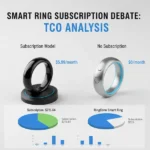
There’s a dirty secret in the smart ring world: the subscription model. Brands like Oura pioneered the “hardware + monthly fee” approach, and while it funds their R&D, it’s a massive turn-off for users.
The future of smart rings is trending back toward “Ownership.” Competitors like RingConn and Ultrahuman are winning over the community by offering “lifetime” data access with the initial purchase. My prediction? The big players will eventually have to drop the monthly fees for “basic” data and only charge for “premium” features like AI-driven hormonal coaching or medical-grade reports for your doctor.
A Page Out of the Future: 2026 and Beyond
By the time we hit the late 2020s, Future of Smart Rings and the distinction between a “smart ring” and a “medical device” will blur. We will see rings specifically designed for:
- Athletes: Focusing on VO2 Max and “Strain” scores that rival a chest strap.
- Seniors: Incorporating fall detection and “heart rhythm” alerts that go straight to their family’s phones.
- The Digital Nomad: Built-in 2FA (Two-Factor Authentication) tokens for ultra-secure remote work.
The smart ring isn’t just a shrunken smartwatch. It’s a fundamental change in how we relate to our bodies. It’s the first piece of technology that actually feels like it belongs on a human being rather than being strapped onto one.
Additional Thoughts: The Invisible Revolution
The most successful technology is the kind you forget you’re using. My smart ring doesn’t beep at me. It doesn’t demand I “close my rings.” It just sits there, quietly gathering the data I need to live a better life.
When people ask me about the future of smart rings, I tell them it’s not about adding more features; it’s about making the ones we have more invisible. We are moving toward a world where your health data is a background process, and your digital interactions are as natural as a gesture.
If you’re waiting for the “perfect” time to jump in, that time is now. The hardware has matured, the apps are intuitive, and the convenience is undeniable. Just do yourself a favor: get the sizing kit first. Your future self (and your swollen morning fingers) will thank you.
The Future of Smart Rings: FAQ
Do smart rings work better on Android or iPhone? Currently, both platforms are well-supported, but Android has a slight edge in “system-level” automation. However, iOS apps tend to have more polished user interfaces. The “best” choice usually depends on which ecosystem you’ve already invested in.
How long will the battery last in five years? With the shift toward solid-state batteries and more efficient Bluetooth Low Energy (BLE) chips, the industry goal is a 10-to-14-day battery life. We may even see “no-charge” rings that run off body heat for basic tracking.
Can I wear a smart ring while weightlifting? I’ve learned the hard way: be careful. “Ring avulsion” is a real (and terrifying) thing. While most smart rings are made of tough titanium, the pressure of a barbell can scratch the ring or, worse, hurt your finger. Most insiders recommend using a “silicone protector” or simply moving the ring to your non-dominant hand during heavy lifts.
Will a smart ring replace my Apple Watch or Galaxy Watch? For many, yes. If you use your watch for notifications and calls, the ring isn’t there yet. But if you primarily use your watch for sleep and health tracking, the ring is a superior, more comfortable alternative.
Are smart rings waterproof? Almost all reputable smart rings carry an IP68 or 10ATM rating, meaning you can swim, shower, and even dive with them. However, I always recommend rinsing them with fresh water after a dip in the ocean to prevent salt buildup around the charging pins.
How do I get the right size? Never buy a smart ring based on your “jeweler’s size.” Your fingers swell throughout the day. Always use the manufacturer’s plastic sizing kit and wear the “dummy ring” for at least 24 hours—including overnight—before making your final choice.
Additional helpful information:
- You can use your smart ring to unlock your phone – Unlock Your Phone With NFC Smart Ring
- Today, there are many things you can use your smart ring for – 50 Unique Ways to Use Your Smart Ring
- Here are some tips and tricks you can explore with your smart ring – Unlock Your Smart Ring: Top Hacks & Tricks
- Take a look at some of the popular smart rings – Comparison of Popular Smart Rings
- What are the features to consider when buying a smart ring? – Smart Ring Buying Guide: Find the Perfect Fit for You