The Morning My Ring Knew I Was Sick Before I Did
To many, Heart Rate Variability (HRV) is just a mysterious number that fluctuates in their Oura or Galaxy Ring app. But once you pull back the curtain on how these sensors actually talk to your nervous system, it becomes the most honest conversation your body has with you.
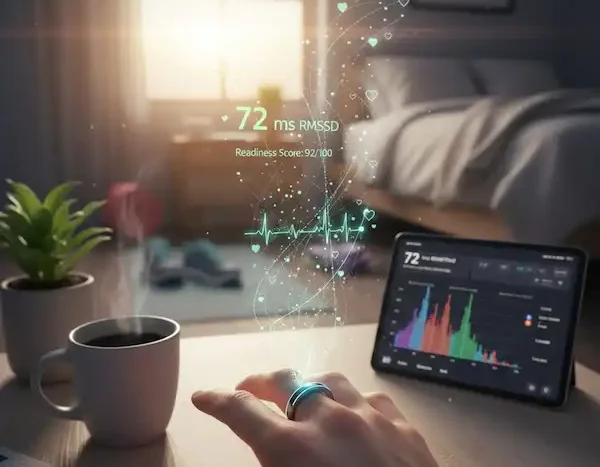
A few months ago, I woke up feeling fine. I had coffee, checked my email, and was ready to hit the gym for a heavy leg day. Then I glanced at my smart ring data. My HRV—which usually sits comfortably in the 60s—had cratered to 22. My “Readiness Score” was screaming at me to take a rest day.
I ignored it. I thought, “I feel great, the sensor must be glitchy.” Halfway through my second set of squats, a wave of fatigue hit me like a freight train. By that evening, I had a 101-degree fever. That was the moment I realized that smart ring HRV health metrics aren’t just “cool data”—they are a leading indicator of physiological storms.
What Exactly Are Smart Ring HRV Health Metrics?
Most people assume a healthy heart beats like a metronome—perfectly steady. In reality, a healthy heart is “chaotic.” Heart Rate Variability (HRV) measures the variation in time between each individual heartbeat.
If your heart rate is 60 beats per minute, it doesn’t beat exactly once every second. One interval might be 0.9 seconds, the next 1.1 seconds. These millisecond-level differences are controlled by your Autonomic Nervous System (ANS).+1
The Two Sides of the Coin
Your ANS has two branches that are constantly playing tug-of-war:
- The Sympathetic Nervous System (SNS): This is your “Fight or Flight” mode. When you’re stressed, caffeinated, or exercising, the SNS takes over. It makes your heart beat more like a metronome—very steady and predictable—which results in a low HRV.+1
- The Parasympathetic Nervous System (PNS): This is your “Rest and Digest” mode. When you are recovered and relaxed, the PNS is in charge. It allows for more variation between beats, resulting in a high HRV.+1
The Insider Secret: Why the Finger is King
Having worked closely with developers in the wearable space, there is a reason why rings like the Oura Gen 4 or the Samsung Galaxy Ring are often more trusted for HRV than wrist-based trackers.
The skin on your wrist is thick, and the arteries are deep. To get a signal, a watch has to shine light through layers of muscle and bone. The finger, however, has a high density of capillaries and much thinner skin. This allows the Photoplethysmography (PPG) sensors to capture a much cleaner “pulse wave.”
When we talk about smart ring HRV health metrics, we are looking at the RMSSD (Root Mean Square of Successive Differences). This is the industry-standard mathematical formula used to quantify the “rest” signal from your heart. Because the ring sits so snugly against the digital arteries, the signal-to-noise ratio is significantly better than what you’d get from a loose-fitting smartwatch.
How to Interpret Your HRV Trends
One of the biggest mistakes new users make is comparing their HRV to their friends. I have a friend who is an ultra-marathoner with an average HRV of 40, while my sedentary neighbor sits at 90.
1. Establish Your Baseline
Your ring needs about 14 days to understand what “normal” looks like for you. During this time, don’t change your habits. Your smart ring HRV health metrics are only useful when compared against your own historical average.
2. The “Green Zone” (Stable HRV)
If your HRV is within 5-10% of your baseline, your body is in homeostasis. You are handling your current “load”—whether that’s work stress or physical training—effectively.
3. The “Dip” (Low HRV)
A significant drop in HRV usually means your Sympathetic nervous system is overactive. Common culprits include:
- Alcohol: Even one glass of wine can tank your HRV by 20% overnight. It’s a literal toxin that your body has to work overtime to process while you sleep.+1
- Late Night Meals: If your body is busy digesting a heavy steak at 10 PM, it can’t focus on cellular repair.
- Incoming Illness: As I learned the hard way, a sudden dip often precedes a cold or flu by 24-48 hours.
4. The “Spike” (Unusually High HRV)
Wait, isn’t high HRV always good? Not necessarily. An abnormally high spike (well above your baseline) can sometimes signal that your body is “overreaching” or trying desperately to recover from extreme exhaustion. If you feel “wired but tired” and see a massive HRV spike, it’s often a sign of a strained system.
Using HRV to Optimize Your Life
Data is useless without action. Here is how I use my smart ring HRV health metrics to tweak my daily routine:
Training with “Intelligent Intensity”
In the fitness world, we call this HRV-guided training. If my HRV is high, I do my heavy lifting or high-intensity intervals (HIIT). If it’s low, I pivot to a long walk or restorative yoga. This prevents overtraining and keeps my cortisol levels in check.
Stress Management
If I notice a downward trend over three days, I know I need to intervene. I’ll prioritize 10 minutes of box breathing (4 seconds in, 4 seconds hold, 4 seconds out, 4 seconds hold). Slow, rhythmic breathing directly stimulates the Vagus nerve, which boosts the parasympathetic response and, subsequently, your HRV.
The Sleep Connection
HRV is most accurately measured during sleep because your body is (hopefully) free from the “noise” of movement and caffeine. I’ve noticed that if I keep my bedroom temperature at 67°F (19°C), my HRV stays about 15% higher than if the room is 72°F. Your smart ring HRV health metrics can help you “A/B test” your environment.
RMSSD vs. SDNN: The “Insider” Distinction
To really get a handle on those smart ring HRV health metrics, we need to talk about what’s happening “under the hood.” When you look at your app, you’re usually seeing a single number, but that number is a distilled version of several complex calculations.
In the world of health tech, we often joke that RMSSD is the “sprint” and SDNN is the “marathon.”
RMSSD (Root Mean Square of Successive Differences)
This is the primary metric most smart rings (and even chest straps like the Polar H10) use. It focuses on the tiny, millisecond-by-millisecond changes between beats.
- Why it matters: RMSSD is heavily influenced by the Parasympathetic Nervous System (the “brake” on your heart).
- The Insight: It is the most reliable marker for short-term recovery. If your RMSSD is high, your “vagal tone” is strong—meaning your body is successfully calming itself down after stress.
SDNN (Standard Deviation of NN Intervals)
This looks at the variability over a longer period (often 24 hours).
- Why it matters: While RMSSD tells you how you are recovering right now, SDNN tells you about the overall “carrying capacity” of your nervous system.
- The Insight: It is more of a longevity and total-stress-load metric. If your SDNN is consistently low over weeks, it’s a sign of chronic burnout or systemic inflammation that a single rest day might not fix.
Designing Your HRV-Based Weekly Routine
Using your smart ring HRV health metrics to build a schedule isn’t about being lazy; it’s about being surgical with your energy. Here is how I structure a “Dynamic Week” based on those numbers:
High HRV Days (The “Green Light”)
- The Routine: This is when you go for your Personal Best (PR) in the gym. If you’re a runner, do your hill repeats.
- Work/Life: This is the day to schedule that difficult presentation or the high-stakes negotiation. Your brain is physiologically more resilient to cortisol spikes today.
- Nutrition: You can handle a bit more “metabolic flexibility” here—maybe a slightly higher carb intake to fuel the heavy output.
Baseline/Stable HRV Days (The “Steady State”)
- The Routine: Zone 2 cardio (steady jogging or cycling where you can still hold a conversation) or moderate strength training.
- Work/Life: Focus on deep work and administrative tasks. You have “average” focus levels.
- Nutrition: Stick to your standard, clean anti-inflammatory diet to maintain this stability.
Low HRV Days (The “Yellow/Red Light”)
- The Routine: Active recovery. Think walking, mobility work, or a very light swim. If the drop is more than 20% below your baseline, consider a “full stop” rest day.
- Work/Life: Protect your peace. If possible, avoid unnecessary conflicts. Your “fuse” is physically shorter today because your nervous system is already red-lined.
- Nutrition: Focus on high-density micronutrients and hydration. Magnesium glycinate before bed can help “nudge” your HRV back up by relaxing the muscles and supporting the nervous system.
Why “Trend” is More Important Than “Truth”
One insider tip I always give: don’t obsess over the exact millisecond count. Sensors can be affected by how tight the ring is or even how cold your hands are (vasoconstriction can make it harder for the PPG sensor to “see” the pulse).
Instead, look at the slope.
- Is your 7-day average trending up? Your fitness is likely improving.
- Is it trending down while your “Activity Score” is high? You are digging a hole of overtraining.
By treating these smart ring HRV health metrics as a conversation rather than a grade, you stop being a slave to the data and start being a partner with your physiology.
Comparisons: Smart Rings vs. Medical Grade
While smart rings are incredibly accurate (often showing a 98% correlation with ECG in controlled studies), they aren’t medical devices. A clinical EKG (Electrocardiogram) measures the electrical activity of the heart directly. A smart ring measures the mechanical pulse of blood.+2
For the average person looking to improve their longevity, the 24/7 nature of a ring is actually better than a one-time EKG in a doctor’s office. It’s the trend that matters, not a single snapshot.
| Metric | Smart Ring (PPG) | Clinical EKG |
| Method | Optical (Light) | Electrical (Leads) |
| Duration | Continuous (Nocturnal) | Snapshot (Minutes) |
| Best For | Lifestyle Trends | Diagnosing Arrhythmias |
| Accuracy | Very High for RMSSD | Gold Standard |
Frequently Asked Questions
Why does my HRV change so much every night?
Your heart is incredibly sensitive. Everything from the blue light you saw before bed to a slightly stressful conversation can shift the needle. Look at the 7-day rolling average rather than getting hung up on one single night.
Can I “fix” a low HRV?
You don’t “fix” it; you respond to it. If it’s low, your body is asking for resources. Hydrate, sleep an extra hour, and cut back on the stimulants. Consistent cardio and omega-3 supplementation have also been shown to improve baseline HRV over months.
Does age affect my smart ring HRV health metrics?
Yes, significantly. HRV naturally declines as we age. A 20-year-old might have a baseline of 100, while a 60-year-old might be at 30. This is why you should never compare your “score” to others.
Can smart rings detect heart conditions?
While some rings are gaining FDA clearance for Atrial Fibrillation (AFib) detection, they are primarily wellness tools. If your HRV is consistently erratic or you feel palpitations, always consult a cardiologist.
Moving Forward with Your Data
At the end of the day, your smart ring is a compass, not a commander. If your smart ring HRV health metrics are low but you feel like a million bucks, listen to your body—but maybe keep the workout to 80% intensity. If the ring says you’re ready but you feel exhausted, rest.
The goal of this technology is to rebuild the bridge between our busy minds and our physical bodies. It’s about learning to speak the “language of the heart” so you can live a longer, more resilient life.
Additional Helpful Information
Review the smart ring tracking accuracy – Smart Ring Health Tracking Accuracy